

If you google “NBC climate reporter,” the first person to come up is Chase Cain.
For nearly eight years, the veteran meteorologist covered the most existential threat to humanity for one of the country’s biggest broadcast networks, traveling to Antarctica, reporting from inside the Palisades fire, and earning lots of big awards along the way.
But Cain isn’t an NBC climate reporter anymore, he tells HEATED in an exclusive interview. Last week, the veteran journalist resigned, citing burnout from near-constant internal fighting to get important climate stories on air—stories that he says were routinely deprioritized, buried late in newscasts, or cut entirely.
“It just really got to that point where I was just kind of exhausted by the sales, by the constant trying to explain and remind, like, hey, this is important. Please run this story,” Cain told HEATED. “It just wore on me after a while.”
In our conversation, Cain talks about the subtle ways climate coverage is suppressed at NBC—not through explicit directives, but through a thousand small cuts over time. HEATED podcast producer Tracy Wholf, a veteran of both CBS and ABC, shares similar experiences. ”The networks, I think, are bending the knee to the current political atmosphere,” she says.
Listen to the full conversation at the top of this newsletter. It’s also available on all your podcast apps and YouTube.
How corporate broadcasters bend the knee
Coincidentally, Media Matters has just released a report analyzing climate coverage at NBC, CBS and ABC over the last year. And the data backs up everything Chase and Tracy say in today’s show.
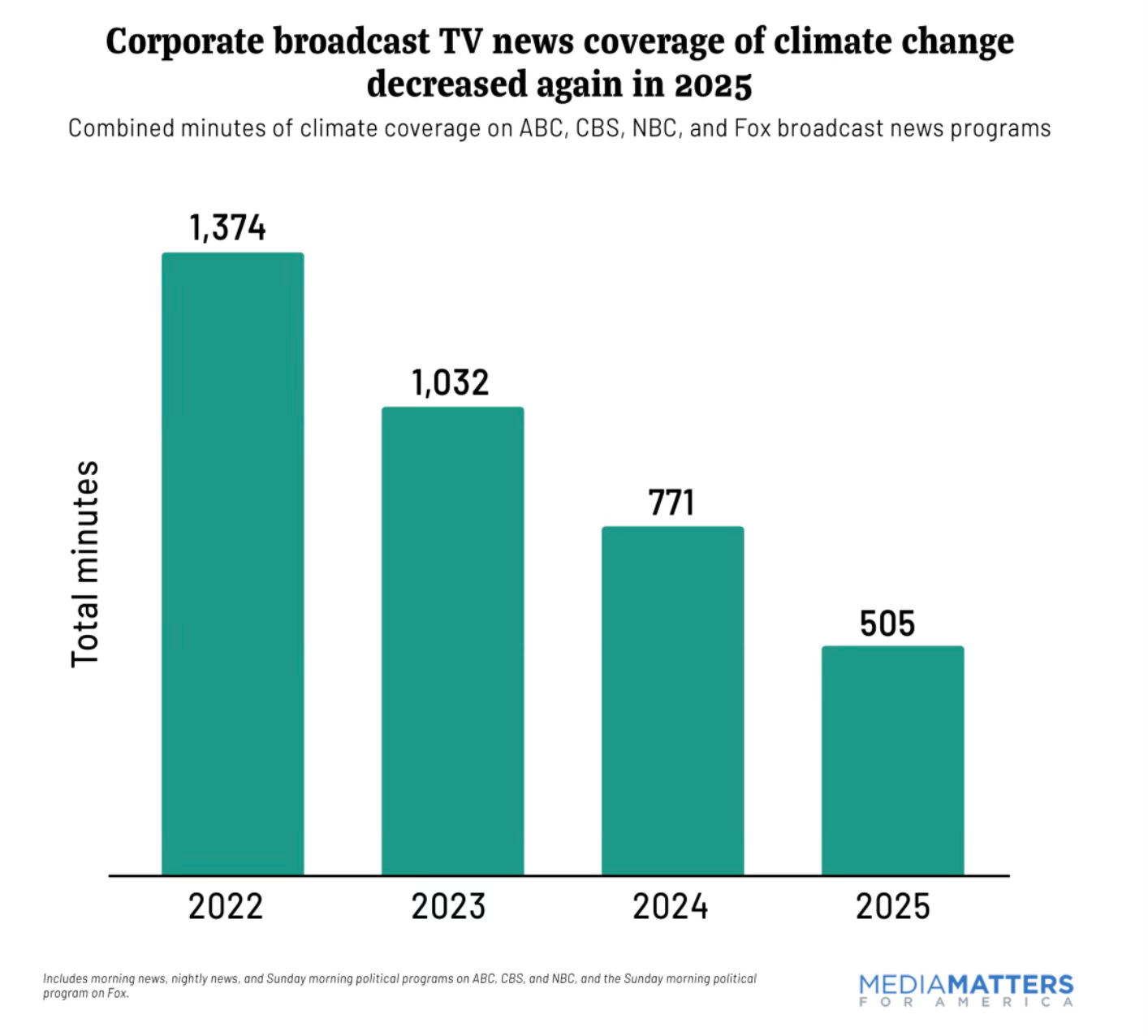
According to that report released Wednesday, corporate broadcast climate coverage dropped 35 percent from 2024 to 2025—from 771 minutes to 505 minutes across NBC, CBS, and ABC combined.
Even more stunningly, only 8 percent of all corporate broadcast climate segments mentioned fossil fuels, the main driver of climate change. So even when corporate news networks do cover climate change, they systemically refuse to explain why it’s happening.
There is no journalistic reason for any of this. The United States suffered 23 separate billion-dollar weather disasters in 2025—the third-most on record. That alone should have warranted lots of airtime for climate stories.
More importantly, 2025 was the year Trump declared war on the planet. He gutted the EPA, rolled back climate and clean air regulations, scrubbed federal climate data from public access, and overall began a systematic dismantling of decades of environmental protections. This will translate directly into more people getting sick, more communities destroyed, and a hotter, more dangerous planet.
And yet the networks largely looked away. According to the Media Matters report, corporate news networks only aired a combined 30 segments about Trump’s climate actions in 2025, representing just 15 percent of their total climate coverage. ABC News was the worst on this, running only 4 segments about Trump’s rollbacks for the entire year. NBC aired 10 such segments.
CBS aired the most segments covering Trump’s climate actions in 2025—16 in total. And that was very likely because of Tracy.
In our episode today, Tracy talks about what it was like constantly fighting for those segments. "I constantly felt like the ugly stepchild,” she said. “aPeople would see me coming down the hall and run.”
She and Chase also talk about what it might mean for these networks now that they’ve pushed out the loudest people fighting for those stories from the inside.
Key moments from today’s show
If you're short for time and can’t listen to the full conversation, here are some of the most illuminating things Chase said about the challenges of covering climate change at a major corporate broadcast network:
On needing to seem “objective”: “It just felt like I was just constantly, to use a sports analogy, in the play-by-play booth—having to stay back at arm’s length and hold up this supposed objectivity about this subject. But for me, it’s really hard to be objective about all life on planet. How can I be objective about the air that I breathe?”
On being compelled to give a platform to liars: “I don't want to go to an oil company and give them a chance to lie to me. I don't want to go to a lobbying group and let them misrepresent what's happening and mislead viewers and cut into the time that I have to actually communicate what's going on. … We know that oil is making the planet hotter. I don’t need the oil company to lie to me and say that it’s not.”
On avoiding climate talk during extreme weather events: “It kind of reminds me of some of the conversations when there's a mass shooting. It's like, now's not the time to talk about gun reform because there are people mourning. Isn’t that the exact moment to talk about gun reform? Isn’t it the exact moment to talk about climate change when you have a weather event that is amplified by climate change?”
On pandering to climate deniers: "[There’s] this perception that the climate deniers in America are this big group. And that if they cover climate too much they're gonna lose viewers. I would argue exactly the opposite."
On the downsides of leaving: “I want more impact, but I also recognize that I was having impact. There were [climate] stories on TV. And so, I guess there's a little bit of guilt in here too.”
Chase is taking a big risk leaving his steady job to go independent. As someone who did the same thing for similar reasons seven years ago, I know that risk well.
But I also know we have an incredible community here, many of whom will be interested in Chase’s journey, and the stories he’ll tell now that he’s free to do as he pleases. I’m rooting for him and I hope you will too.
You can follow Chase’s reporting by subscribing to his YouTube channel. You can also find him on TikTok and Instagram.


