

People say all the time, metaphorically, that the country is on fire. Right now, the country is also actually, literally on fire.
There are currently 27 uncontained large wildfires currently burning across the United States. Three near the Florida Everglades have torched an area the size of Manhattan. Another in Washington state has destroyed at least 15 homes and burned an area roughly the size of Miami. Another Washington wildfire, near Spokane, has forced the evacuation of 12,000, with one person presumed dead. And in Idaho, evacuations are underway as a major fire threatens more than 120 homes.
Because of this, the National Interagency Fire Center on Thursday raised the country’s wildfire preparedness level to 3 out of 5. Level 3 means the country is not yet in total wildfire emergency mode, but that the situation has become serious enough across multiple regions that state and local firefighters are increasingly calling for national backup.
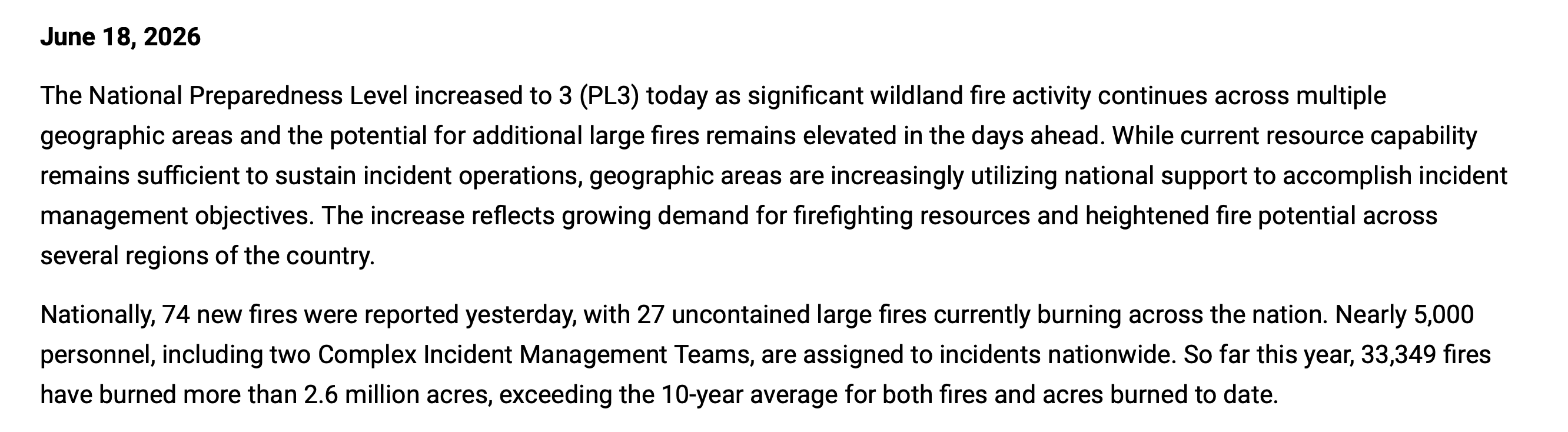
The problem here is that it’s June. The average preparedness level for June over the last decade has been 2, while level 3 is more typical of July. But this is in line with what experts have been predicting about this year’s fire season: That it’s going to be horrifying.
“Key environmental indicators show that the nation is a tinderbox,” Inside Climate News recently reported, “gripped by widespread drought and with a light snowpack in the mountains that will offer little relief as its remnants melt away.” Already this year, 33,349 fires have already burned more than 2.6 million acres, a little over 4,000 square miles. That’s about 63 percent higher than the 10-year average for this point in the year.
Fossil fuels and industrial meat and deforestation are exacerbating this situation for the normal reasons you’ve likely already heard a million times: greenhouse gases trap heat, a warmer planet makes things hotter and drier, and hotter, drier landscapes burn more easily.
But another aspect of this I don’t hear talked about as often is how climate change is making wildfires harder to fight. It used to be that firefighters could get a lot of important work done at night, when temperatures dropped and humidity rose. But a study published this spring in Science Advances found that we are losing some of that nighttime break, as hotter, drier nights allow fires to keep burning after dark and flare up earlier in the morning. Since 1975, the study found, the number of hours when weather is favorable for wildfires has increased 36 percent.
Of course, there are other problems contributing to our increasingly horrific wildfire woes. For example: We keep building more and more homes deeper into fire-prone landscapes. And in many places, there is simply more stuff to burn, thanks to decades of fire suppression and a persistent shortage of prescribed burns and other fuel-clearing work.
But this is all precisely why wildfire experts have been warning that we need more capacity to respond and prepare. Obviously, the federal government can’t stop fire season from happening. But it can reduce the damage in various ways.
And yet. And yet!
It’s almost feels too obvious to say, but here we go. At the exact moment when wildfire experts are warning that the country needs more capacity to prepare, respond, and recover, the Trump administration is doing the opposite. Here are some actions from just the last few months.
The Trump administration is withholding FEMA fire prevention grants from blue states, including California and Colorado. The Washington Post reported last month that roughly 1,000 FEMA hazard mitigation grants have been held up in Trump’s second term, including about 20 wildfire-related projects across the West, mostly in California and Colorado. Since July 2025, California has received just $830,000 from the program—less than 1 percent of what it received in the previous five months—while it waits on $1.68 billion. Colorado, meanwhile, has received no federal disaster-prevention funding since July 2025. The delayed projects include grants to clear dangerous vegetation, create defensible space around homes and evacuation routes, and help communities prepare before the next fire hits.
The Trump administration is also blocking USDA wildfire grants unless states sign on to its culture war agenda. Last month, Stateline reported that new U.S. Forest Service contract terms require states to comply with Trump executive orders on DEI, immigration, gender identity, and other issues before they can receive wildfire funding or sign forest management agreements. In Washington state, that means $49 million in federal wildfire money is stuck—including grants for communities to reduce wildfire hazards, train and equip volunteer firefighters, clear dangerous fuels, and protect homes—because state officials say the new language conflicts with state law.
The Trump administration is also taking a chainsaw to the science that helps us see dangerous fires coming. Axios reported this month that cuts to NOAA, CIRES, and related science programs could weaken the forecasting work used to track drought, dry vegetation, and the short-term wind patterns that can turn a fire into a catastrophe. Scientists told Axios that this work helps agencies position crews, harden infrastructure, and identify wind-prone areas where utilities may need extra safeguards.
The Trump administration is also significantly cutting Forest Service research. Federal News Network reported that Trump is moving to close 57 of the Forest Service’s 77 research facilities nationwide, and the agency’s 2027 budget request would eliminate roughly 800 of 1,110 Forest Service research scientist jobs. That means less federal expertise on wildfire, drought, forest health, post-fire recovery, invasive species, and the basic science land managers need to keep forests (and people) alive.
The Trump administration is using wildfire risk as cover for an obvious logging giveaway that could make fires worse. Inside Climate News reports that the administration is moving to rescind the Roadless Rule, which has protected millions of acres of national forest from roadbuilding and logging for more than two decades. USDA says this is about “responsible forest management” and fire prevention. But that is a scam: fewer than 1 percent of wildfires in the lower 48 states since 2010 have started in roadless areas of national forests. In addition, the Roadless Rule already allows emergency firefighting and work to reduce wildfire danger near communities. What rescinding it would actually do is let industry punch roads into some of the country’s last intact public forests—bringing more logging, more development, and more human ignition risk into places that are currently among the least disturbed landscapes we have left.
The Trump administration has already fallen behind on the actual vegetation-clearing work that can reduce wildfire risk. NPR reported in May that the Forest Service entered this fire season having done far less work than in recent years to clear the dry, flammable vegetation that can fuel catastrophic fires. In 2025, the agency reduced vegetation on almost 1.5 million fewer acres than in 2024, and prescribed burn acreage fell to about half of what it was in 2023 and 2024.
All of this is happening alongside the obvious larger fact: Trump is also making climate change worse. He’s paying energy companies billions to abandon renewable energy projects (On Wednesday, he announced yet another deal to stop four more offshore wind projects, bringing the total taxpayer spend to $2.5 billion). He’s doling out taxpayer money to the coal industry like it’s candy (and some of the coal plants he’s funding have a history major environmental violations). He’s slashing and burning climate and environmental regulations from the country’s most-polluting sectors. He’s decimating climate research in general.
So when people say Trump is content to watch the world burn, I’m not sure we should treat that as a metaphor. Obviously, wildfire season was going to happen with or without him. But his administration is making wildfire season far more dangerous than it has to be.
There are actual people caught in the crosshairs of these decisions. So for this week’s podcast, we wanted to talk to two people who are trying to navigate what this looks like in real life.
First, I spoke with Savannah Bradley, co-founder of A Resilient Tomorrow, a community-led disaster recovery organization launched after the Eaton Fire by Black women with deep roots in Altadena. I wanted to talk to Savannah about what it feels like to still be recovering from one devastating wildfire while the next wildfire season is already here—and about what her group is advocating for as Altadena tries not just to rebuild, but to rebuild in a way that protects the people who already call it home.
Then I went to Capitol Hill to speak with Savannah’s representative, Rep. Judy Chu, about what it means to fight for that kind of recovery in Congress: what federal support is still missing, what it takes to get disaster money to the people who need it, and how lawmakers should be thinking about who pays as climate disasters become more destructive and more expensive.
The episode is also a little different from our usual show. We filmed it in Washington, D.C., at the Museum of Unnatural Disasters, a pop-up exhibit from the Climate Action Campaign designed to show how climate change is making disasters feel less and less “natural”—and to center the actual people living through them.
Unfortunately, in a plot twist that was a little too on-the-nose, the museum was unexpectedly forced to close early the day we filmed because of preparations for Trump’s America 250 celebration. A museum about climate disasters getting its permit revoked to make room for a taxpayer-funded celebration of Trump’s America. Subtle!
Anyway. You can watch the full episode above, listen wherever you get podcasts, or find it on YouTube.
In other news…
In the interest of not always leaving you on a gloomy note, here’s a potentially uplifting piece of news: The New York Times reports today that the Trump administration is abandoning its plan to dismantle the Ocean Observatories Initiative, the $368 million ocean monitoring system critical to understanding climate change and marine ecosystems. From the article:
The Senate passed a measure Wednesday that would block the government from dismantling the system, with lawmakers in both parties warning that the action would be illegal and would threaten the safety of coastal communities. The Trump administration had also tried to cut the program’s funds the last two years, but Congress restored the money both times. …
The measure was sponsored by Senators Jeff Merkley, Democrat of Oregon, and Lisa Murkowski, Republican of Alaska. In impassioned remarks on the Senate floor on Wednesday, Ms. Murkowski said the network collected data crucial to understanding El Niño, the powerful weather pattern that formed this month in the tropical Pacific.
“This is all happening at a time when everybody’s talking about El Niño and what that is going to bring in terms of the potential for extreme weather events,” she said. “This is not the time to be turning off one of our most valuable scientific assets.”
Who knew!


