


Want to listen to today’s story instead of reading it? You can find audio/podcast links at the top of this newsletter, and video on YouTube.
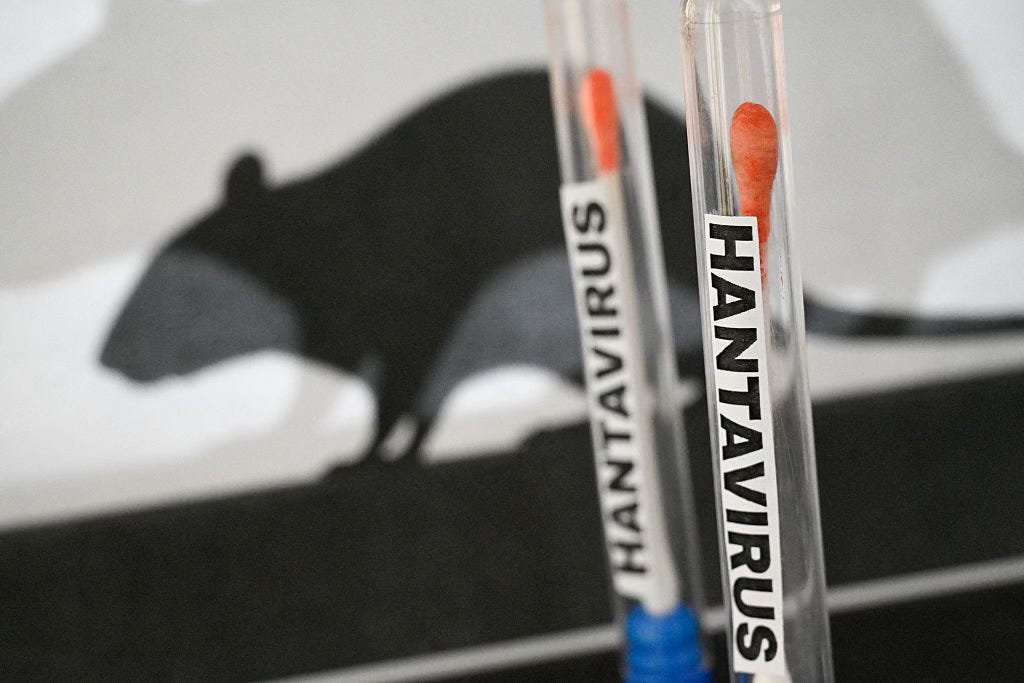
In the month since a deadly hantavirus outbreak was first reported aboard the MV Hondius, the story has become many things: A story about our lingering COVID-19 trauma, a story about how shitty America’s global outbreak response has become, and a story about how how no one should ever go on a cruise, even if it is an awesome Arctic expedition.
But three infectious disease scientists I spoke to this week told me that hantavirus also needs to be a climate change story—specifically, about what happens when an increasingly hotter and chaotic planet reshuffles where diseases can spread.
If we ignore or dismiss the climate angle of the hantavirus story, “we miss the opportunity to get ahead of the curve,” said Kirk Osmond Douglas, director of the Centre for Biosecurity Studies at the University of the West Indies in Barbados, who has studied the connection between hantaviruses and climate change.
“Climate health models allow you to see into the future what could potentially be,” said Douglas. “And knowing what’s coming … would actually save you a lot of money, and potentially also a lot of lives as well.”
So what is coming when it comes to hantaviruses and climate change? How are they connected? And how could the rapidly approaching Super El Nino—a phenomenon worsened by climate change—affect the spread of hantavirus and other infectious diseases?
That’s what we’re going to explore today.
Hotter planet + infectious diseases = bad
Reporting on the climate impact to a specific disease outbreak is a little like reporting on the climate impact to a specific hurricane or wildfire as it’s happening. Without an attribution study, it’s really difficult to pinpoint the exact influence.
In the case of this specific outbreak of the Andes virus—the only strain of Hantavirus known to spread from person to person—we still don’t even know exactly where it originated. One rapidly-spreading theory is that the first known patient was exposed while birdwatching near a landfill outside Ushuaia, Argentina, but local officials, birding guides, and medical experts have strongly pushed back, saying it likely originated further north.
But even without that information, we can talk about the conditions that make hantavirus outbreaks more likely. And generally speaking, a hotter planet and infectious diseases are a bad mix, at least for humans. A 2022 study in Nature Climate Change found that over half of known infectious diseases have already been made worse, in some way, by climate hazards.
In many cases, that’s because a changing climate allows disease-carrying wildlife to spread in places they didn’t used to, said Dr. James Shepherd, an infectious diseases specialist at Yale University:
As the planet warms, as the environment heats up, then the range of diseases also changes, because diseases that are tropical or subtropical can now become temperate diseases. If their vectors and their reservoir hosts can move northwards, for instance—which is what we’re seeing with tick transmitted infections—then they can move into areas that had never seen them before.
The good news is that hantavirus is not a tropical or subtropical disease, so it’s not at risk of moving into temperate zones. The bad news is that it’s already a global disease. There are more than 40 types of hantavirus across the world, and they exist in rodents pretty much everywhere.
So in terms of climate change, infectious disease experts aren’t so much worried about hantavirus reservoir hosts (that’s science-term for disease-carrying rodents) moving from tropical zones into temperate zones. They’re more worried about them moving from nature into places where humans live, work, and generally exist.
How climate change is pushing humans and rodents together
To be clear: there are many non-climate-change reasons that rodents are increasingly moving from nature into places where humans are. Across the world, we’re cutting down more forests, expanding more farms and cities, and pushing more roads and mines deeper into wild habitats.
But many studies show that, in addition to those factors, climate change is also pushing rodents into closer contact with humans.
Back in 2021, Dr. Douglas helped conduct a systematic review of the scientific literature around hantavirus and climate change. What he found was that, in areas where climate change was making things wetter, rodent populations were exploding. He told us:
When you have a lot of rainfall, what happens? The soil moisture increases, plant and vegetation growth increases, and then you get a production of food and food availability for the rodent. And so you get a population boom within the rodent population. And when you do that, then you increase the risk of humans coming into contact either directly with rodents or indirectly with contaminated dust through the infected rodents excreted, whether this be feces or urine. … Flooding can also flush rodents out of their habitat and then rodents will be dislocated and oftentimes they find themselves closer to human dwellings.
Rodents and humans also risk coming into more contact in places where climate change is making drought worse, too. Here’s Dr. Douglas:
Droughts also impact negatively on food availability … So you have less food available, [the rodents] go seeking food from somewhere. And what do humans do during droughts? Particularly within the Latin America region, they store grain. That’s where you have the most attraction for rodents … [which] also brings them into closer contact with humans.
This pattern has also shown up in human disease data. A 2024 study in JAMA Network Open found that after severe flooding in China’s Yangtze River basin, the risk of rodent-borne hantavirus disease remained elevated for up to three years.
Of course, the data can be complicated. One study in Arizona, for instance, found that extreme flooding didn’t help the area’s dominant kangaroo rat population—it nearly wiped them out completely. Meanwhile, however, the area’s pocket mice survived and surged, permanently changing which rodents dominated the landscape.
So the picture of climate change’s impact on weather and rodent population can be complicated. But it’s not the only way climate change worsens the spread of infectious diseases like hantavirus.
Climate change worsens urbanization and biodiversity loss
Climate change is also worsening other problems that are contributing to disease spread—like increased urbanization, or, put another way, the exodus of people out of rural areas and into cities, where rodents thrive. Here’s Dr. Shepherd.
One of the great effects [of climate change] on us, as hosts of infections, is that we’re moving. … But we’re moving because we can no longer sustain lifestyles that used to sustain us for millennia, like subsistence farming, for instance, in Africa. There are parts that are getting too dry or too wet or too unpredictable. …
So we’re urbanizing a vast movement driven by climate, driven by unpredictability, driven by the difficulties of growing food in a very unpredictable climate. This is resulting in massive expansion of cities, primarily in the hotter, poorer parts of the world. The biggest cities in the world in 50 years are nearly all going to be in Africa. And they’re going to be projected close to 100 million people in some of these cities.
Another problem that climate change is worsening is the loss of biodiversity. The IPCC has found that, with every little bit of warming, extinction risk rises: at 1.5°C, the median share of species at very high risk of extinction is estimated at 9 percent, at 2°C it’s 10 percent, at 3°C its 12 percent, and so on, and so on. That’s not good for diseases.
“As biodiversity goes down, as environments are denuded, often things that carry infections and transmit infections, hosts and vectors, tend to be more robust,” Dr Shepherd said. “They move in.”
Still, overall, scientists are clear that it’s difficult to pinpoint the precise influence of climate change on this specific strain of hantavirus. Here’s Dr. Angel Desai, an infectious disease physician at the University of California, Davis.
It’s tough because while there are all of these things going on with climate, there’s also all these other things going on in the context of human behavior. So it’s always a challenge to be able to parse out what exactly is specifically related to climate-related factors and what’s related to the other factors. But in my mind, I think that it’s all connected together, and that’s driving these changes we’re seeing in infectious diseases.
Why talking about the climate connection is important
Still, each scientist I spoke to was adamant that, even if we can’t pinpoint the exact influence of climate change on the Andes virus outbreak, it’s still worth talking about.
One reason is because, in the very near future, forecasters predict we’re about to experience one of the strongest El Nino events in recorded history—an event made stronger by climate change. That may impact rodent populations around the world, but also specifically in Argentina and Chile, where the Andes virus originates. Here’s Dr. Shepherd:
When you’re having what we’re gonna have later this year, a very strong El Nino year, which is gonna be stronger because the planet’s much warmer than it was before. The rodent populations in the wet, humid, agricultural areas of the world tend to explode and overpopulate, have massive increases. And that will increase the number of... pathogens that they carry and introduce into the environment
Another reason it’s wise to talk about climate change in relation to this hantavirus outbreak is that it highlights the need for governments to invest in research models that take climate change into consideration when forecasting disease outbreaks. Here’s Dr. Douglas:
Why can’t you forecast the risk of infectious diseases that can assist you in planning and preparing just like you would for a hurricane? You don’t want to wait until the hurricane is at your door to ensure you have food supplies, ensure that you have taken all the necessary preparative steps to minimize the impact. It’s not that you’re going to prevent it. It’s to mitigate and to reduce the risk.
Overall, the scientists I spoke with said this hantavirus outbreak highlights the fact that the conditions for infectious disease outbreaks are changing faster than our systems for predicting and preventing those outbreaks.
And in a climate-changed world, we can no longer think of diseases like hantavirus as something to eradicate. “As far as infectious diseases are concerned, they are here forever,” Shepherd said. “They’re part of our environment. They’re part of the natural order of things.”
That doesn’t mean outbreaks are unavoidable. It means disease risk is fundamentally shaped by the health of the natural world. “We need to recognize that we’re not top dog,” Shepherd said. “We’re just another member of an exceptionally complex interdependent ecosystem.”
Destroying habitat, reducing biodiversity, and rapidly warming the planet do not just harm “nature” in some abstract sense. They also weaken some of the barriers that help keep pathogens away from people. And ultimately, by disrupting the environment so completely, Shepherd said we are likely to fuel more pandemics.
“We have to recognize that we are part of a complex, biodiverse planetary system,” Shepherd said, “and that we screw with it at our peril.”
Special thanks to Drs. Kirk Osmond Douglas, James Shepherd, and Angel Desai for sharing their expertise that informed this story.


