
Fossil fuel propaganda is evolving
A new analysis of nearly 2,000 fossil fuel ads finds Big Oil has moved from green promises to insisting oil and gas are inevitable. (They're not).

A side effect of the war in Iran is that fossil fuels are falling out of favor. People are starting to realize that sunlight can’t get stuck in the Strait of Hormuz; that EVs can’t have their fuel supply held hostage on a tanker; and that there’s no such thing as a barrel of wind.
It’s probably no coincidence, then, that Big Oil is working overtime to polish its reputation as prices surge and black clouds of poison fill Tehran’s skies. Take this ad from the American Petroleum Institute that aired last week on The New York Times podcast The Daily, during an interview with climate writer and activist Rebecca Solnit.
“Today, America’s natural gas and oil keeps the country moving, growing and building, and makes every day a little easier,” the ad’s narrator says. “But energy demand is growing, and the infrastructure built today will help secure a more affordable, reliable future, with enough energy to go around.”
It’s strange, given the current geopolitical situation, hearing the oil industry tell us that the only way we’re going to have an affordable, safe, and consistent future is to continue to invest in fossil fuels (reminder: even “American” oil is still priced on a volatile global market).

But this type of messaging is not just limited to this political moment, or to The Daily. A new report from the advocacy group Clean Creatives reveals that the oil industry has systematically reshaped its advertising over the past four years to portray fossil fuels as permanent, indispensable, and necessary for economic stability and national security.
Put another way, fossil fuel companies are no longer trying to convince us they are good-faith partners in the fight to preserve a safe and stable climate.
Now, they are focused on convincing us that the world is only safe and stable if they are in charge.
“State of the Art Propaganda”
Before we get into the details of this new report analyzing fossil fuel advertising, it’s important to just ground ourselves briefly in why we care about these advertisements in the first place.
Oil companies spend nearly $7 billion a year on media, creative advertising, and PR. They do this for one reason, and one reason only: because it works.
Ads are one of the most effective ways the oil industry buys social license to operate—that is, permission from the public to maintain business as usual. Without that social license, the industry would be more vulnerable to regulation or other attempts to reform it or (gasp!) transition away from it.
“The fossil fuel industry’s ad campaigns are state of the art propaganda developed in partnership with public relations experts and based on almost a century of collaborative experience,” Geoffrey Supran, a Harvard University researcher who studies fossil fuel communications, told us back in 2019. Fossil fuel ads are such an obstacle to climate action that United Nations Secretary-General António Guterres has publicly called for a worldwide ban.
That’s why it’s so important to know how the oil industry is trying to manipulate us. Because they are very likely, to a certain degree, succeeding.
”From Greenwashing to Gaslighting”
Understanding this manipulation is why Clean Creatives analyzed a whopping 1,859 ads from BP, Shell, ExxonMobil, and Chevron between 2020 and 2024—everything from social media ads to TV spots to executive speeches.
What they found was a coordinated evolution in the story Big Oil is telling about itself. “Greenwashing has taken on a new form,” said Nayantara Dutta, the report’s lead author.
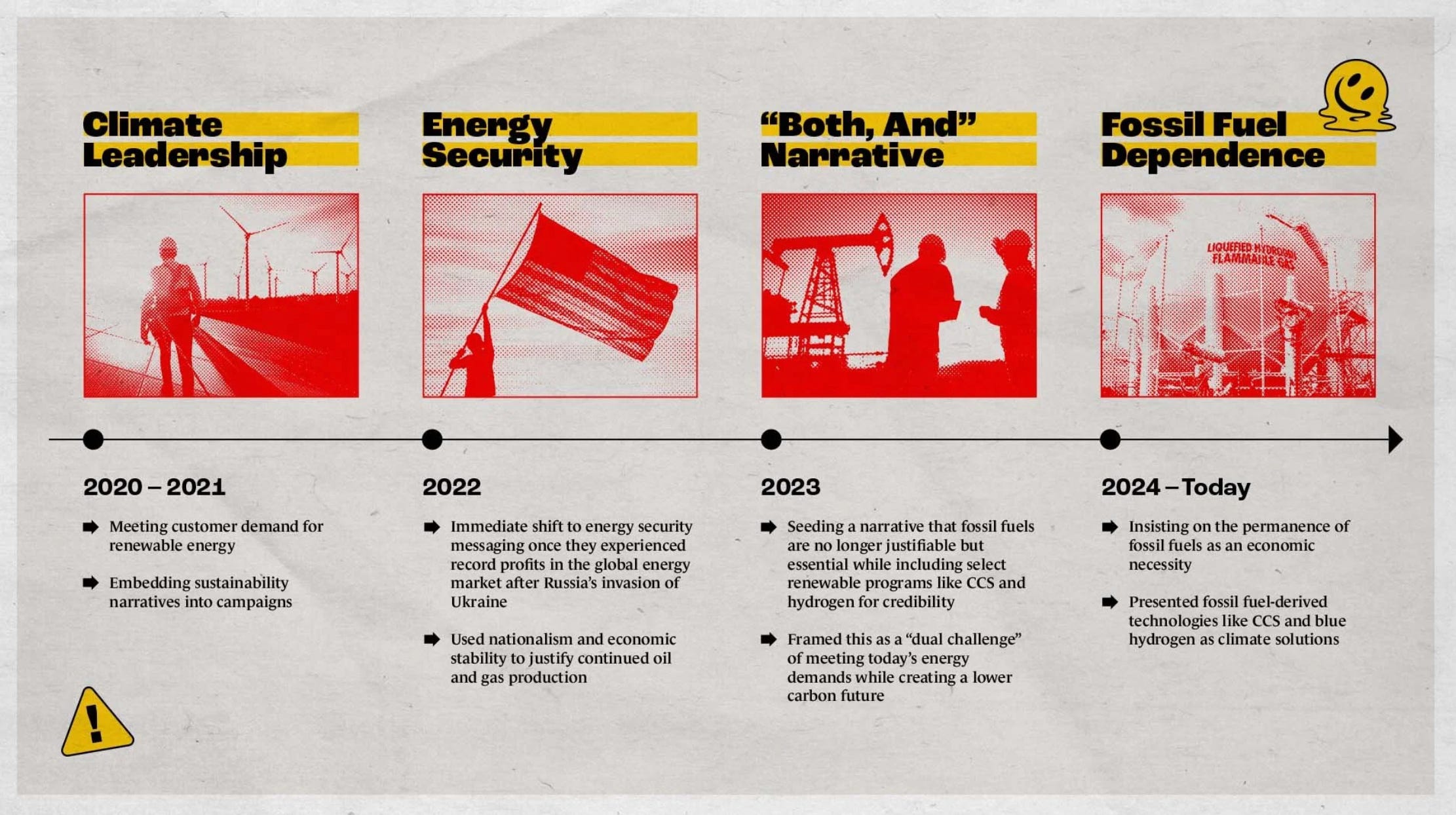
In 2020 and 2021, oil companies were still all about your straight-up, typical sort of greenwashing. Their ads were filled with net zero pledges, “clean” energy investment promises, wind turbines, sunsets, and dogs. (We covered that phase a lot in the newsletter).

Then, in 2022, Russia invaded Ukraine—and almost overnight, the messaging changed. Instead of talking non-stop about energy transition, the report found, companies started emphasizing security. Fossil fuels were no longer framed as a problem to be phased out, but a safeguard against chaos.
(This is almost certainly because most of the big oil companies actively stopped investing what little money they already had in the energy transition and went back all-in on fossil fuels. So much for that happy wind-swept dog!)
By 2023, the industry had landed on a new argument: We can do both. We can expand fossil fuel production and address climate change! We can drill more oil and lower emissions!
But by “do both,” the industry really just meant “drill more oil” and “drill more oil but call it climate-friendly.” This is where you start seeing heavy promotion of things like carbon capture, hydrogen, and “lower-carbon” fuels—technologies that sound climate-friendly, but conveniently preserve the central role of oil and gas.
But by the time Trump was re-elected in 2024, even that balancing act started to fade. Many ads stopped pretending there was transition happening at all, and instead settled into something much more blunt: fossil fuels aren’t going anywhere. In fact, they’re essential.
Shell, for instance, began emphasizing liquefied natural gas as a long-term pillar of the energy system, dramatically increasing its focus on LNG in its strategy and communications. Its CEO also started framing LNG as a climate solution. (Spoiler: It’s not).
API’s recent ad in The Daily is evidence that this industrywide messaging shift continues. “API’s ad in The Daily clearly demonstrates the focus on energy security and domestic oil and gas production we discovered in our analysis,” Dutta told HEATED.
She added: “It’s crucial to keep in mind that the API is supported by at least 6 advertising and PR agencies helping them with their media buys, narrative framing, and creative. The New York Times should follow other news outlets, like The Guardian and Vox, which have banned fossil fuel ads since 2020 and 2021, respectively.”
Reminder: oil is not inevitable
Across companies, platforms, and countries, the fossil fuel industry’s message is clear: You need us, and this is just how the world works.
But it’s important to remember: The oil industry is spending $7 billion a year telling you oil is inevitable not because it’s true, but because it desperately needs everyone to believe it. If everyone does not believe this, they are screwed.
There’s a line that circulates online about gender: If the binary were natural, it wouldn’t need to be enforced by law. The same logic applies here. If fossil fuels were truly inevitable, there would be no need for a constant, multi-billion-dollar campaign to convince us of that fact. It would just be.
Instead, what we have is an industry that must relentlessly assert its own permanence. That insistence is not evidence of inevitability. It’s just the sound of power trying not to lose control.
The climate cost of war with Iran
It gives me no pleasure to report that I wrote about what a declared war with Iran would mean for the climate a little more than six years ago.
Given our current reality, I’ve removed the auto-paywall for archived posts so anyone can read it. You can find it here.
Want to hear me talk more about fossil fuels?
You’re likely aware by now that HEATED has its own podcast. (Make sure you’re subscribed for our episode on Thursday, where I’ll watch some fossil fuel ads with report author Nayantara Dutta and give you my reactions!)
But I also go on other podcasts, too—and they’re WAY fancier than mine! Recently, I was on A Matter of Degrees, a super thoughtful show hosted by Dr. Leah Stokes and Dr. Katharine Wilkinson. The podcast tells stories about the powerful forces behind climate change and the tools we have to fix it.
On my recent episode, we talked about the inseparable connection between authoritarianism, state violence, and fossil fuels. They did a great job with it and made me sound very smart. Check it out here, or listen on Apple or Spotify.
It’s so difficult to stay anchored to science and reality when the lies about fossil fuels flood our screens. Emily Atkin, thank you for reminding us we’re not crazy!
You accomplish veracity among the mire of blurb that surrounds media today; a beacon in the fog of lies & graft that fuels the abomination of our world. I seek your words to keep my footing…