
AI’s water problem is worse than we thought
A new investigation reveals how Amazon is amplifying Oregon’s nitrate pollution crisis.

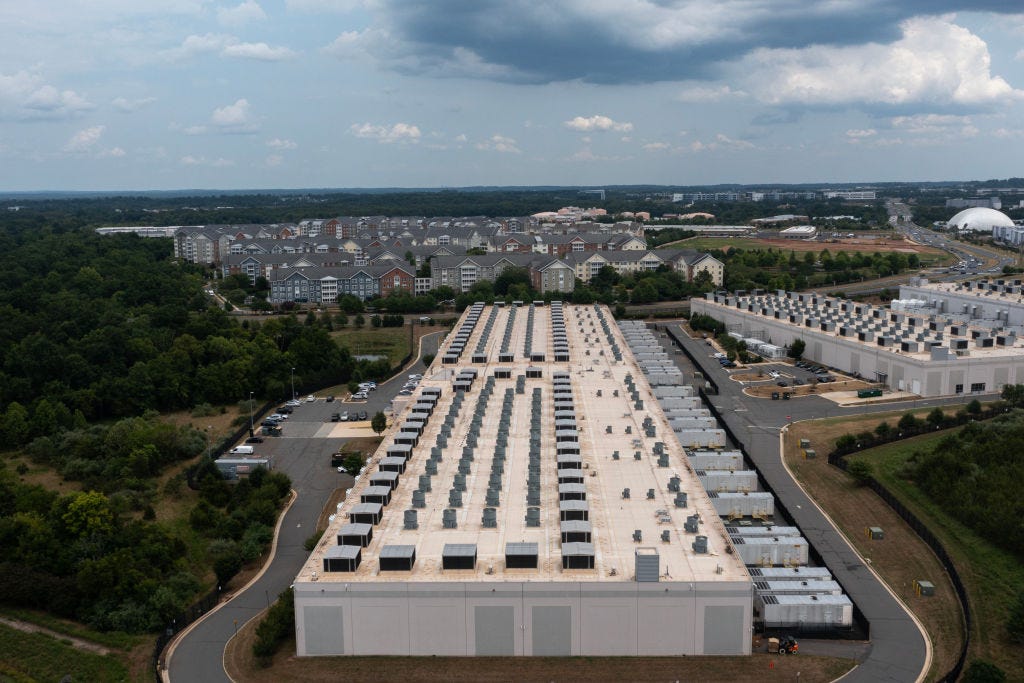
Everyone knows data centers use a lot of water. What’s less known is how they can poison the drinking water that remains.
It’s already happening in eastern Oregon, according to a new bombshell investigation from Rolling Stone and the Food and Environment Reporting Network. (FERN is an independent, nonprofit news organization that seeks to make the food system more sustainable and equitable).
Here’s the gist: At its data centers in Morrow County, Amazon is using water that’s already contaminated with industrial agriculture fertilizer runoff to cool down its ultra-hot servers. When that contaminated water hits Amazon’s sizzling equipment, it partially evaporates—but all the nitrate pollution stays behind. That means the water leaving Amazon’s data centers is even more concentrated with pollutants than what went in.
After that extra-contaminated water leaves Amazon’s data center, it then gets dumped and sprayed across local farmland in Oregon. From there, the contaminated water soaks straight into the aquifer that 45,000 people drink from.
The result is that people in Morrow County are now drinking from taps loaded with nitrates, with some testing at 40, 50, even 70 parts per million. (For context: the federal safety limit is 10 ppm. Anything above that is linked to miscarriages, kidney failure, cancers, and “blue baby syndrome.”)
FERN and Rolling Stone’s new investigation thoroughly explains that process of contamination, follows the people living with that fallout, and exposes the political machinery that enabled all this: namely, a decades-old network of local power brokers who residents literally referred to as “the mafia.”
It’s a remarkable piece of public service journalism that gives a preview of what could happen as data centers multiply across rural America to fuel the artificial intelligence boom, often in places with scarce water, weak oversight, and political systems easily overpowered by Big Tech money. I highly recommend setting aside some time to give it a read.
ICYMI: Our deep dives into AI
If you’d like to learn more about the full environmental footprint of AI and data centers—from climate impact to how communities are fighting back—here are three essential pieces from the HEATED archives.
AI is guzzling gas. The AI boom is driving a rapid expansion of methane gas infrastructure—pipelines and power plants—to power the technology. Experts say this could have devastating climate consequences if fully realized. Key quote:
“There is just no possible way to achieve net zero when you’re adding tens to even hundreds of gigawatts of more gas power to the system.” - Tyler Norris, electric power systems researcher at Duke University.
Oil companies are using AI to extract more fossil fuels. AI’s climate problem isn’t just that the process itself uses a lot of energy. It’s that oil companies are using the technology to increase their production. Key quote:
“From what I saw, I believe that finding and extracting more oil is one of the biggest use cases of AI today.” - Will Alpine, former AI software engineer at Microsoft.
How grassroots climate activists are taking on Big Tech. In Virginia, a small conservation group is leading the fight against the powerful and secretive data center industry. Key quote:
“This is the biggest climate issue we’re facing right now.” - Tim Cywinski, communications director for the Virginia Sierra Club.
Catch of the Day: This is Luna ready to go for a walk, during which she will almost certainly collect many cans and bottles. What an eco-pup!

Thanks to reader Margaret for the submission.
Want to see your furry (or non-furry!) friend in HEATED? Just send a picture and some words to catchoftheday@heated.world.
I watch and read a lot about financials and economics and it's becoming very clear that all of these data centers are headed for a financial fall soon. AI is all speculative and when the investors finally realize they've been had and pull the plug, the AI industry in the U.S. is going to go the same way that the real estate bubble went back in 2008.
Then we may be seeing a bunch of data centers close down due to lack of money. Then what? Will anyone go in there and try to clean up the mess? Probably not. Then all of that tech hardware will rot and leak more pollutants into the local soils around the country while the owners claim bankruptcy.
Do we think the Trump government will step in to assist with the cleanup? These are the same people that just choked off the EPA. I don't see anything good coming from any of this in any way.
Thank you for this important news Emily, and for all your work ! After sharing with an epigenetiscist, he was surprised that the nitrate levels stated (50 to 70 ppm) would be associated with miscarriage, and indeed on the link behind that comment, the authors of the scientific study say "We conclude that the current literature does not provide sufficient evidence of a causal relationship between exposure to nitrates in drinking water and adverse reproductive effects". I think the threshold to declare a causal link is pretty high, so I'm sure this doesn't negate any anecdotal evidence of effects, but in the interest of being able to tell this person that investigative journalists don't spread misinformation, I thought I would point it out !!