
AI’s climate problem is worse than we thought
A new study reveals that AI’s climate impact extends far beyond its massive data center footprint.

Until this point, the public conversation about AI and climate change has been laser-focused on the vast amount of electricity used to power the technology.
For good reason. Over the last few years, the AI boom has rapidly increased society’s appetite for fossil fuels via the electricity consumption of data centers. Data center electricity consumption has sent tech companies’ emissions soaring, knocked their climate plans wildly off course, and pulled them directly into the fossil fuel business.
(Some mind-bending recent examples: Microsoft just signed a deal with Chevron to develop a massive gas plant in Texas explicitly for data centers. And Amazon is planning to build the largest fossil fuel power plant ever to exist in the United States to power its AI.)
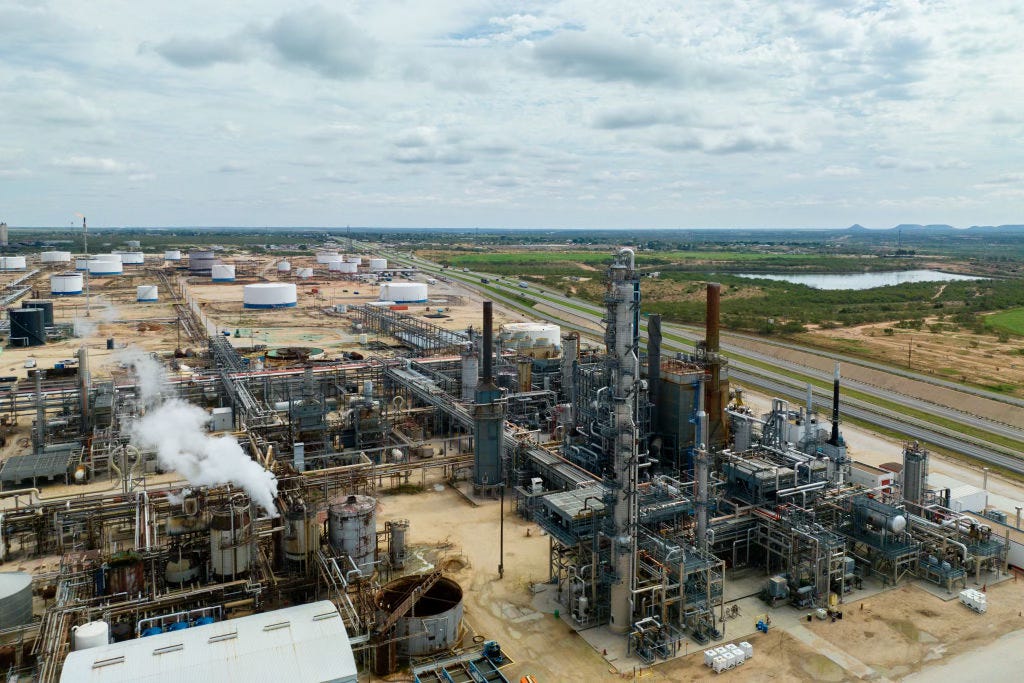
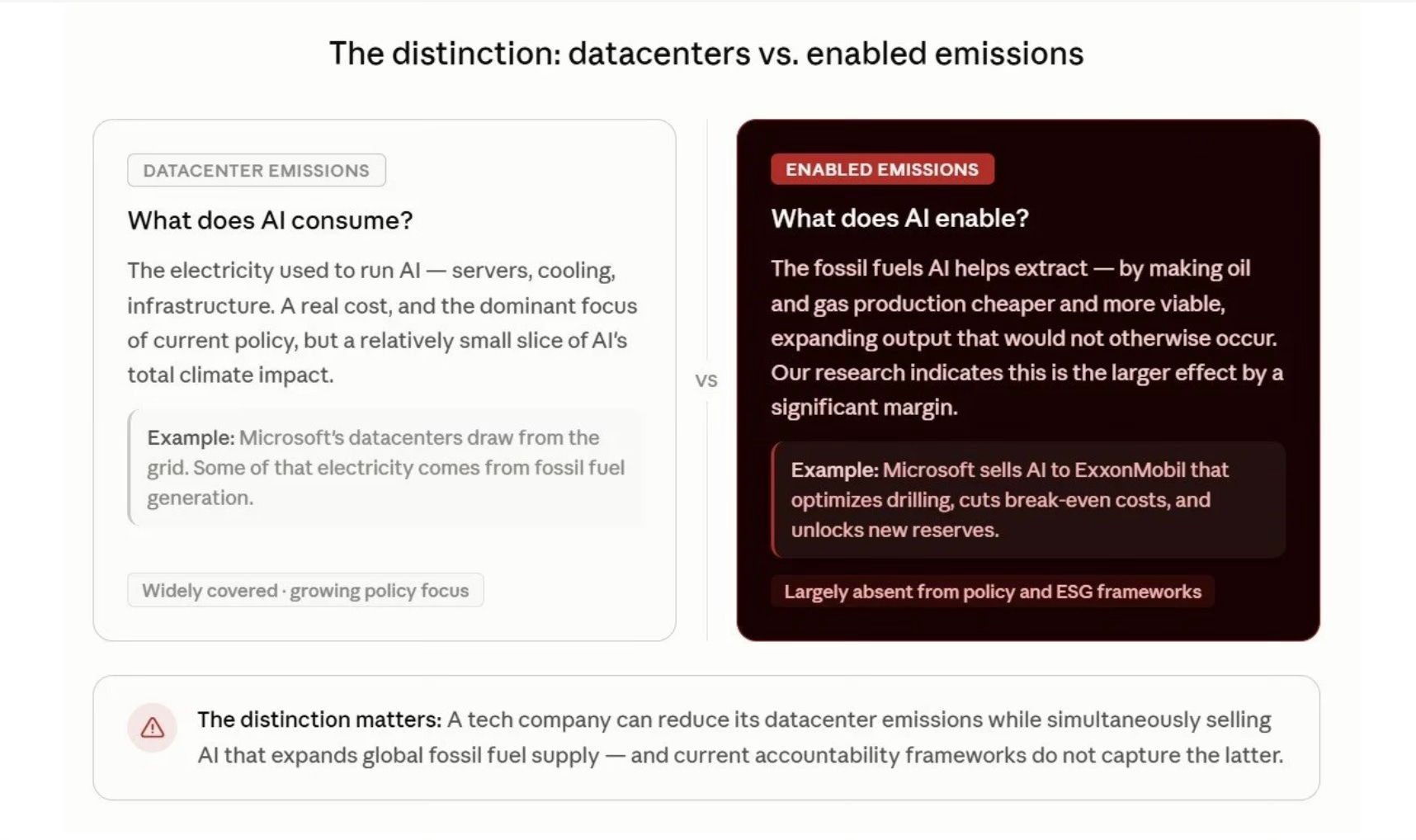
And yet, this is only the tip of the AI climate iceberg. Because AI is not only consuming fossil fuels to generate electricity—it is also helping the world’s biggest oil companies produce more fossil fuels quicker, cheaper, and for greater profit.
Over the last few years, AI has become a powerful tool for oil and gas companies, helping them locate new deposits, drill wells faster, and extract more from existing fields.
These aren’t just generic AI tools, either. “There are teams of engineers and salespeople at these tech companies that are explicitly for the fossil fuel industry,” Holly Alpine, a former senior manager at Microsoft, told HEATED. “They are engineers writing code explicitly in partnerships with oil majors to expand production.”
Until now, we haven’t known the broad climate impact of these custom-made AI tools for the fossil fuel industry. But a new peer reviewed study published in the journal npj Climate Action is shedding some alarming light.
That paper—co-authored by Holly and her husband Will Alpine, also a former Microsoft employee—shows that the emissions enabled by the fossil fuel industry’s use of AI are likely far greater than the emissions of powering AI as a whole.
Specifically, they found that Big Oil’s use of AI to produce more oil and gas could create 3.3 to 13.3 times more climate pollution than powering AI’s data centers.
On the low end, these tools could enable additional yearly carbon emissions equal to Mexico’s, according to the research. On the high end, they could enable yearly climate pollution equal to Russia’s—the world’s fourth-largest emitting country.
“It is difficult and frustrating for us to see the conversation around ‘the true climate impacts of AI’ just stop at operational emissions,” Holly told HEATED. “We cannot get across enough how important it is to include what [AI] is used for.”
The importance of “enabled emissions”
In 2024, Holly and Will Alpine resigned from high-level positions at Microsoft to draw attention to what they believed was a vast, overlooked source of climate pollution. They now lead Enabled Emissions, a campaign seeking accountability for AI-enabled fossil fuel expansion. (HEATED covered their story last summer).
“Enabled emissions” refers to the pollution a technology helps make possible. For example: In 2019, Microsoft and ExxonMobil announced an AI partnership they said could help Exxon increase production by as much as 50,000 barrels a day. The pollution generated by producing and burning that additional oil and gas would be considered “enabled” emissions: not released by Microsoft’s technology directly, but made possible because of it.
As the Alpines tried to draw attention to enabled emissions, however, they ran into a basic problem: They didn’t know how large the issue actually was.
So they teamed up with Nathan Geldner, an independent researcher in Seattle, and Maksym Chepeliev, an assistant research professor at Purdue University’s Center for Global Trade Analysis, to create a model that could tell them.
To come up with their estimates, the team pulled together existing evidence of how much AI can help fossil fuel companies and renewable energy companies produce their products more efficiently. They then plugged those estimates into a model of the global economy to see how the effects might ripple outward.
Even Holly, who had spent years warning that enabled emissions could be enormous, was taken aback by the result.
“I think the number shocked us when we saw it,” she said. “We knew it was really big, but seeing that number was pretty overwhelming.”
But what about the good AI can do for renewables?
At the heart of the study was a simple question: What happens when AI helps the fossil fuel industry and the renewable energy industry at the same time?
Because importantly, AI is not only used as a tool for oil companies. AI tools can also help solar and wind companies increase performance and efficiency. AI advocates often say these applications will ultimately prove the technology to be a climate benefit.
So the researchers wanted to know: Could the pollution avoided by using AI to help renewables cancel out the pollution enabled by using AI to help fossil fuels?
“I was holding on to a lot of hope that maybe AI can accelerate renewables to get us out of this problem,” Will told HEATED.
But the model, unfortunately, did not bear that hope out. The researchers ran 64 scenarios, varying how much AI improved productivity in fossil fuels, renewable energy and other parts of the energy system. They found that, whenever AI gave both industries a similar boost, global emissions rose. AI had to help renewable energy four to five times more than fossil fuels just for emissions to break even.
In fact, the only research scenarios in which global emissions actually fell were the ones where tech companies stopped helping fossil fuel companies create custom AI tools to increase production altogether.
A call to action: expand the AI-climate conversation
That’s why Holly and Will believe the findings should motivate people to broaden the public conversation about AI’s climate impact beyond data centers.
“Governance inherits the shape of the discourse that informs it,” Will said. “And right now, the topic of enabled emissions has not been recognized.”
Right now, only small steps have been taken to address enabled emissions—and even those are mostly preliminary. A new version of the Science Based Targets initiative’s voluntary corporate standard, released in June and taking effect next year, requires participating companies to identify emissions-intensive activities in their value chains. For the first time, that category explicitly includes data, dedicated software and other technology services that support fossil fuel production.
The Greenhouse Gas Protocol is also considering a new kind of report that could capture the emissions consequences of corporate actions and investments. And a 2024 bill introduced by Sen. Ed Markey briefly mentioned AI used to advance “high-carbon activities.”
But the Greenhouse Gas Protocol change is still being developed. The SBTi standard remains voluntary. And Markey’s bill never became law. Most government efforts to address AI’s environmental impact remain overwhelmingly focused on data centers.
Holly and Will still believe the data center issue is important to address. Their point is that cleaning up the energy used to power AI addresses only one part of its climate footprint—and, this study suggests, potentially the smaller part.
“These are two sides of the same coin, and they amplify each other,” Will said. “It’s actually two fronts in the same fight.”
Addressing both fronts, the Alpines argue, will require rules governing not only how AI is powered, but what companies use it to do. That could mean requiring tech companies to disclose the emissions their products enable, count those emissions toward their climate commitments, and reconsider tools explicitly designed to produce more oil and gas.
To the Alpines, this is not an argument against AI itself. It is an argument against allowing the technology to develop without regard for what it enables.
“We are not categorically anti-AI, and we do not think that AI is fundamentally fossil-based or fundamentally pushing us toward a climate-negative future,” Holly said. “We just need guardrails in place.”
If you reached the end of this story and thought, “I’m glad someone is doing this work,” please consider becoming a paid subscriber.
HEATED is completely independent and entirely reader-supported. Your subscription helps keep truly unbought, uncompromising climate accountability journalism free for everyone to access.


Not sure if you saw Erald Kolasi's and Jesse Damiani's super thorough analysis of how they calculate AI's carbon footprint, but I think this dovetails nicely with your piece. They suggest we're significantly underestimating the related output for data centers owing to a previous lack of a framework for considering the expenditure of resources outside of mere operation of these facilities.
Thanks for highlighting the Fossil Fuel- AI link. Wait a minute: FF-AI Link....maybe an acronym is emerging: FFAIL, or FAIL for short?