

If a nation’s diet requires ecological destruction to sustain it, can it really be called healthy?
There was a time when Robert F. Kennedy Jr. would have said no. Before he became the nation’s top health official, Kennedy built his career arguing that human health and environmental health were inseparable—that pollution in rivers became pollution in bodies, and that climate change itself was a public health emergency driven by industrial systems. His premise was simple: when the ecosystems that sustain life become unstable, human health becomes unstable too.
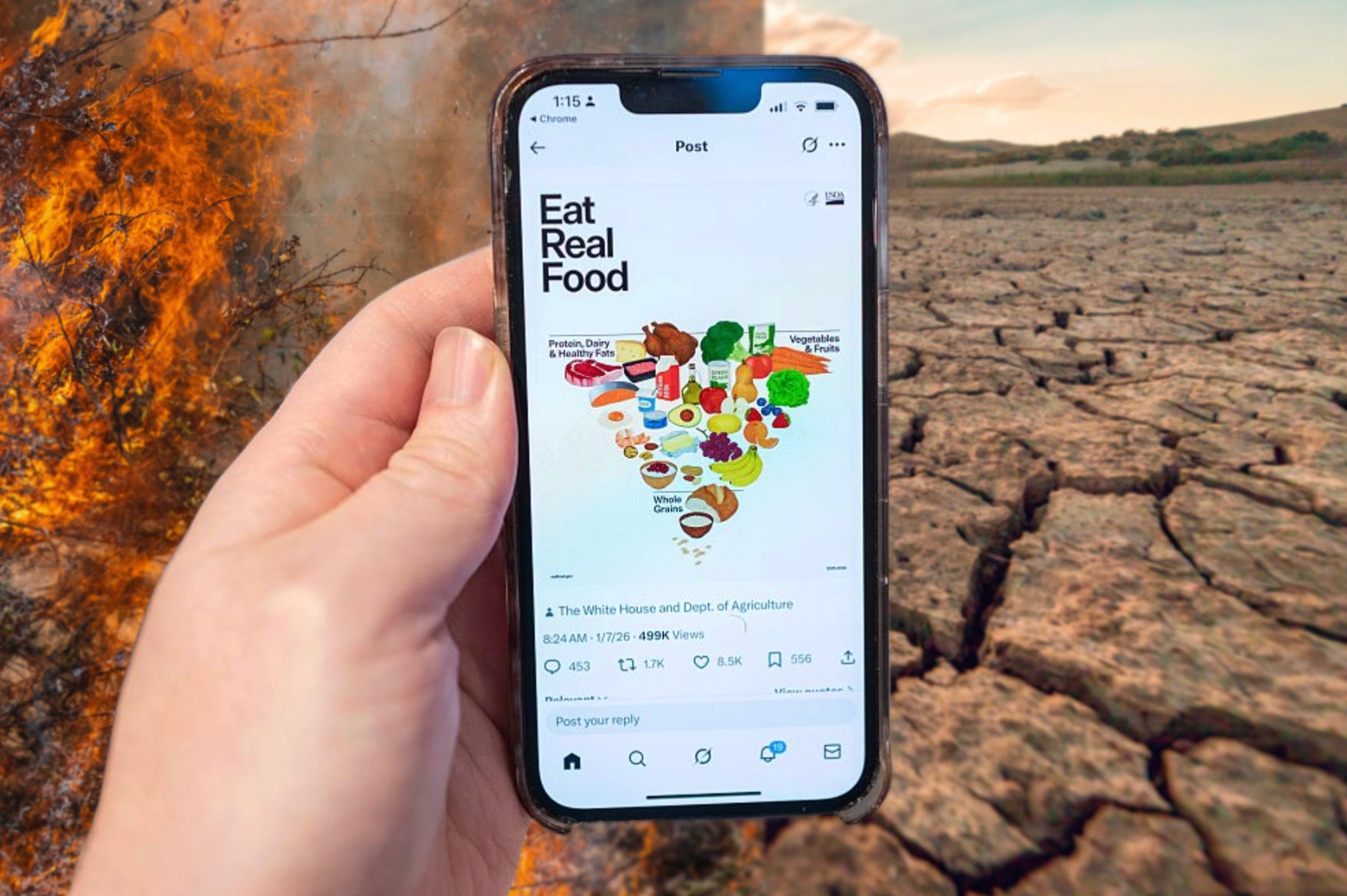
But in office, Kennedy has begun governing as if health begins and ends inside the human body. Nowhere is that clearer than in the new federal food pyramid his department unveiled this week—an inverted version of the original triangle that encourages beef and dairy consumption on nutritional grounds while ignoring the deeply harmful environmental systems required to produce those foods on an industrial scale.
The new inverted food pyramid isn’t merely a poster meant to guide individual choices. It is a set of policy guidelines that directs billions of public dollars toward specific foods, and the agricultural system that supplies them. It determines what food gets bought for school meals, child-care centers, senior-meal programs, and WIC food packages. It guides what foods the government buys for the military and federal cafeterias. It determines how SNAP educates low-income families about “healthy choices.”
In other words, when federal nutrition guidelines shift, the food system shifts with them. And with this new food pyramid, the food system will shift toward producing a lot more beef and dairy—the most resource-intensive and climate-polluting foods we produce at scale.

Americans already eat far more beef and dairy than most of the world. The average American consumes roughly 57 pounds of beef a year—nearly three times the global average—and the United States is the largest consumer of dairy on Earth.
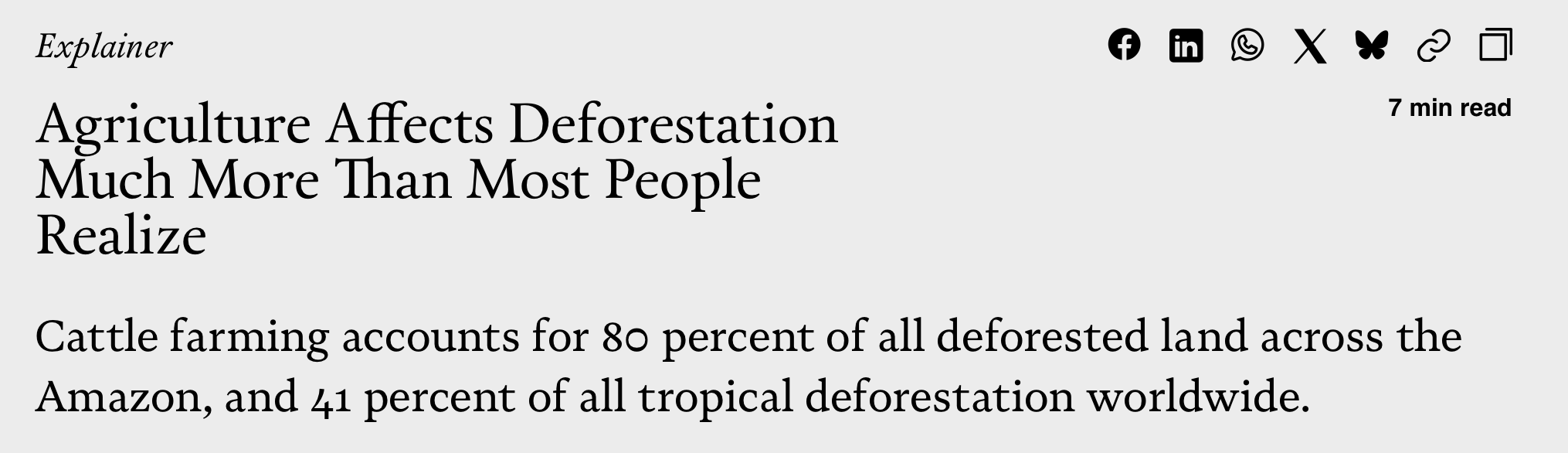
The current rate of meat and dairy consumption is already threatening our health—not necessarily through the act of eating it, but through the impacts of producing such massive quantities of it. Industrialized animal agriculture is one of the largest sources of water contamination in the country. It is a massive contributor to drought in the West; the number one reason for Brazilian Amazon deforestation; and responsible for up to 18 percent of global carbon pollution. Our appetite for meat and dairy are so high that, even if fossil fuel emissions were completely stopped today, the world’s current appetite these products could push warming past the catastrophic 2 degrees Celsius threshold.
Now imagine a world that eats even more meat and dairy than today. The result is straightforward: more cattle, more methane, more water use, and more land dedicated to grazing and feed crops. And where does all that land come from? From native grasslands, prairies, and forests, which are some of the most effective carbon sinks on the planet. Converting them to pasture or cropland releases carbon stored in soils and vegetation and prevents those landscapes from absorbing more in the future. Globally, that process, known as land-use change, is already a major driver of climate change, biodiversity loss, and deforestation.
The United States plays a central role in that system. Much of the grain that feeds American cattle is grown in the Midwest, where fertilizer runoff contaminates drinking water and fuels the annual dead zone in the Gulf of Mexico.
These ecological pressures eventually show up as public-health problems. Nitrate contamination in water is linked to increased risks of birth defects and certain cancers. Fertilizer runoff and algae blooms threaten fisheries and coastal food supplies. And the carbon and methane released through land conversion and cattle digestion worsen climate change, one of the greatest health crises of our time.
Some insist this picture changes with grass-fed or “regenerative” beef. And in certain ways, those systems are better: well-managed grazing can improve soil structure and reduce some local pollution. But they cannot solve the basic math. Pastured cattle require far more land per calorie than feedlot cattle. Scaling that model to satisfy higher demand would require converting vast areas of grassland and forest into pasture—land the country does not have without sacrificing carbon sinks and wildlife habitat.
Even if the land existed, the climate math would still be punishing. Cattle belch methane no matter how they are raised, and methane is an extremely potent warming gas. Soil carbon gains from grazing are too modest and too slow to offset the methane produced over an animal’s lifetime. In practice, fully grass-fed beef remains several times more climate-intensive per gram of protein than poultry or legumes. It works at small scales. It does not work as the backbone of a national diet.
This is my biggest problem with the new food pyramid. It treats food as a purely biological input rather than a public ecological choice—as if health exists on a separate plane from the land, water, and climate that make nourishment possible in the first place. Thinking this way may make sense for individual bodies in the short term. But in the long term, and in the aggregate, it’s deeply irresponsible.
You cannot build a healthy society on top of an unhealthy biosphere. The climate, water, soil, and land that produce our food are as important to our health as the food itself. Without them, all our talk of “healthy eating” becomes a kind of denial—pretending we can thrive while the systems that keep us alive break down.
RFK Jr. used to know that. He used to preach it. But somewhere along the way, his environmentalism went out to pasture.
Previously in the RFK Jr. cinematic universe
Today’s article is the latest in my personal, ongoing quest to make people who care about the environment realize that RFK Jr. is not, in fact, Making America Healthy Again. In case you missed my previous dispatches:
“Make America Healthy Again” is dead. (March 2025)
Kennedy can remove all the fluoride from all the drinking water systems in America. It’s not going to make up for dismantling the Mercury Air Toxics Standards, which are “critical to protect babies from harmful mercury from coal-fired power plants.”
Kennedy can rescind every approval of every food dye currently backed by the FDA. It’s not going to make up for undoing regulations on car and truck pollution, which will lead to “significantly more toxic air pollution from vehicle exhaust, exacerbating the risks of asthma, lung disease, and heart attacks.”
You can remove all the grains and seed oils you want from a kid’s diet. It doesn’t matter if her water is polluted by industrial agriculture and arsenic-tinged coal waste; if her air is full of tiny soot particles that lodge deep into her circulatory system; and if every environmental group she wants to join to fight it is disbanded because their activities have been defunded and/or criminalized.Organic farmers expose RFK Jr.’s delusion. (March 2025)
Last October, Robert F. Kennedy Jr. stood in front of the U.S. Department of Agriculture, and promised that Donald Trump would reform America’s corporate-controlled, synthetic chemical-laden agricultural system. …
Kennedy was asking people to believe something delusional: that Donald Trump would do something bad for the fossil fuel industry. Industrial agriculture is one of Big Oil’s largest and most lucrative markets. Most synthetic fertilizers and pesticides are made from fossil fuels. During the campaign, Trump promised to give the fossil fuel industry anything it wanted in exchange for massive campaign donations—which it gave. So how could Trump possibly “Make America Healthy Again” while committed to a “Drill Baby, Drill” agenda? How does that make any sense?
Obviously it doesn’t. But Kennedy convinced millions it did. And now organic farmers are paying the price.RFK Jr. is full of crap. (May 2025)
Kennedy’s form of environmentalism is the equivalent of toasting all-natural marshmallows over a tire fire. It might make for a good photo, but it’s poison. True environmentalism requires protecting natural resources, listening to scientists, and prioritizing public health over polluter profits. Kennedy used to understand that. Now, he’s full of crap.
Further reading on the new food pyramid
I wasn’t sure where to place this in the main article, so I just left it out. But I do want to be clear that I don’t have an issue with everything in the new food pyramid. Emphasizing vegetables and minimally processed foods and minimal sugar sounds great to me. But there are also lots of issues, and we should be honest about them.
Kennedy said his dietary advisers would have ‘no conflicts of interest.’ Some did. (New York Times)
Three of the nine members have received grants or done consulting work for the National Cattlemen’s Beef Association; one of those also received a research grant from and serves as an adviser to the National Pork Board. At least three members—including two of the same ones who have done work for red meat groups—have financial ties to dairy industry organizations, such as the National Dairy Council. Another is a co-creator of a high-protein meal replacement product. The experts did not write the guidelines, but produced reviews of scientific evidence on which the guidelines were based.
The new food pyramid is lying to you. (Vox).
Emphasizing minimally processed foods is generally good advice, and there is admittedly something refreshing and inspiring in hearing the federal government champion whole foods so vocally. But “just eat real food” is a dubious proxy for nutrition knowledge, and it can misleadingly demonize forms of food and processing that are perfectly fine or beneficial (more on that later).
The new guidelines reasonably recommend stricter limits on added sugars, one of the greatest contributors to poor health in the US, and on refined grains such as white breads. “I think that’s the way it should be,” David Ludwig, a professor of pediatrics at Harvard Medical School and a professor of nutrition at the Harvard T. H. Chan School of Public Health, told me. “Those should be targeted for reduction.”But MAHA instincts cash out most prominently in the guidelines’s central emphasis on eating meat, dairy, and eggs. The tone, text, and visual language of the guidelines make “protein foods” appear as the central food group, with animal foods depicted as the primary source. Plant-based options such as beans, lentils, and nuts are listed as protein options but are barely present and notably subservient to animal products in this food pyramid, and the scientific report released alongside the guidelines emphasizes the importance of animal proteins. The guidelines also instruct Americans to “consume dairy,” which in reality is not necessary for good health, and it’s not clear why fortified soy milk, which was included as an appropriate substitute for dairy in the previous guidelines, was excluded from this document.
RFK Jr.’s new food pyramid draws mixed responses from health experts. (MS Now)
The Trump administration’s new dietary guidelines announced Wednesday were greeted with mixed reviews from nutrition experts, who praised the move to avoid highly processed foods but questioned the guidelines’ focus on more protein consumption.
“There’s good stuff in this and some not-so-good stuff,” said Marion Nestle, a professor emerita of nutrition, food studies and public health at New York University, who called the new guidelines “muddled, contradictory, ideological and retro.”
Why it still makes sense to limit saturated fats. (Undark)
While the science on unsaturated fats has evolved, it hasn’t to the same degree with respect to saturated fats. Even nuanced reviews of saturated fats point to harms for people with cardiovascular risk factors. …
There likely is merit to discouraging [ultra-processed foods]: While not all ultra-processed foods are equally unhealthy, there is an emerging consensus on their adverse effects. … Still, Gardner cautioned against replacing ultra-processed foods with increased consumption saturated fats, which also carry documented harms if consumed in excess.
No Catch of the Day today; e-mail length limit won’t allow it. We’ll be back in your inbox with pet pics soon!
Want to see your furry (or non-furry!) friend in HEATED? Send a picture and some words to catchoftheday@heated.world.
Thanks, Emily. The extra protein step itself is jive. There is a Stanford professor who has been trying to get that message out. Christopher Gardner. I think he has a TED Talk, at least a bunch of videos. Also an Instagram feed. He's really "done the research." I.e. controlled trials, with actual measurements. Measurements showing even the old guidelines said we needed more protein that we really do. https://profiles.stanford.edu/christopher-gardner?tab=bio
I don't know where RFK and his cult get their "information." Particularly since Covid, it's just bizarro land talking to MAHA/MAGA types about food, medicine, "heavy" metals, "toxics," pollution, GHGs, climate change, etc. Some microscopic risks are vastly exaggerated, some major risks are dismissed.
How do you balance a pyramid on its head? The only way to make it work is to stick its head in the sand