Meet the backpacker making Trump's Arctic drilling push go viral
Bentley Hensel prepared for eight months to show people the Arctic National Wildlife Refuge—and nearly drowned while doing it.
TikTok can be a sea of brain-rot, misinformation, and ads. Creators trying to inform the public about environmental issues face an uphill battle.
But last month, Virginia-based engineer Bentley Hensel figured out a way to engage hundreds of thousands of TikTok users on President Donald Trump’s plan to drill in the Arctic: By backpacking through the Arctic and showing people what’s at stake.
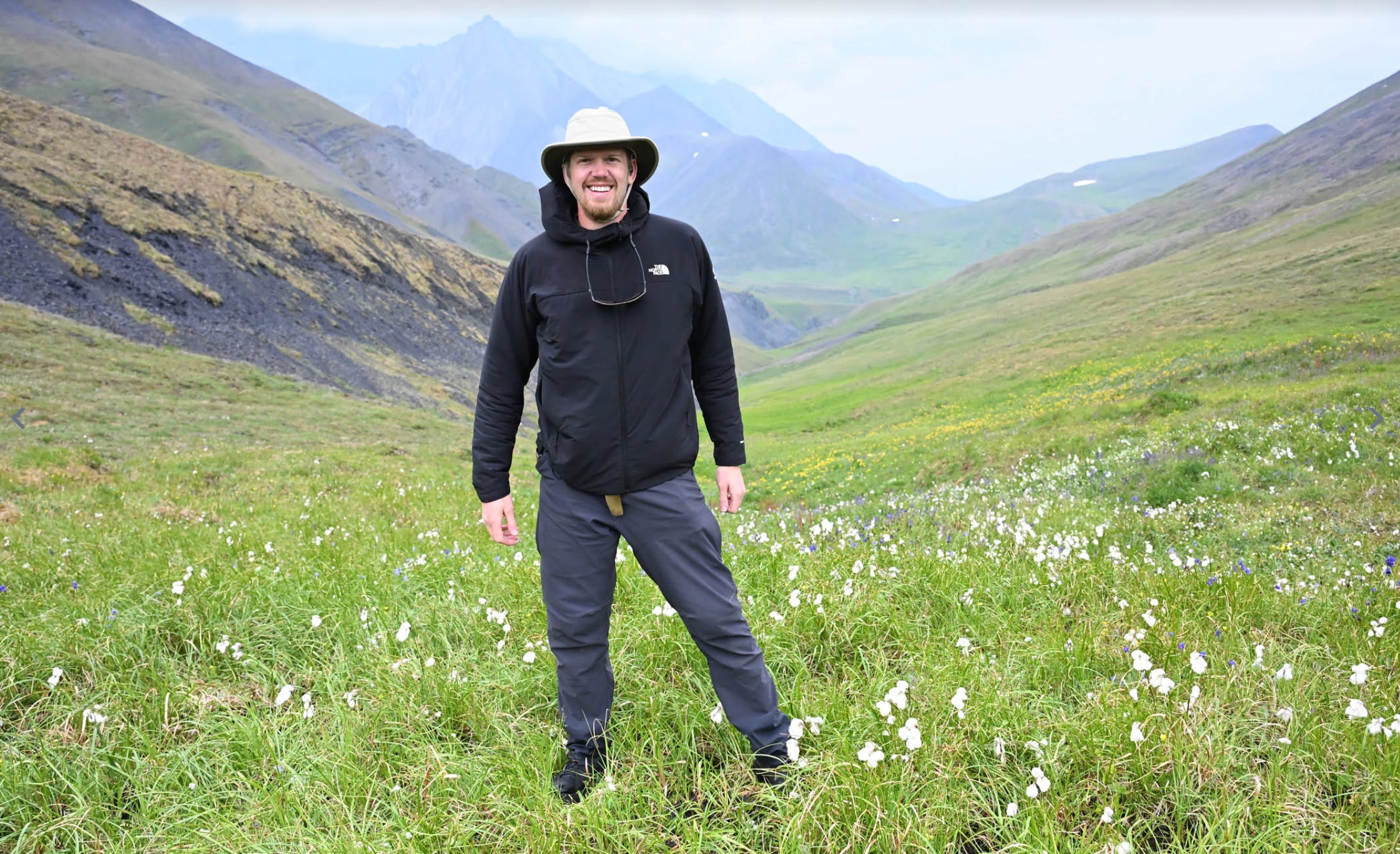
In his viral TikTok—which has so far garnered over 700,000 views and over 16,000 shares—Hensel stands in the middle of the Arctic National Wildlife Refuge in Alaska, one of America’s most remote and delicate ecosystems.

“Do you give a shit about the environment?” asks Hensel, pleading for less than 60 seconds of his viewers’ time. He points to one mountain in the distance. "That’s where Trump wants to drill real bad.”
Stressing that he’s not seeking income, Hensel—a former Congressional candidate—asks for anyone who sees the video to simply connect him to members of the media who will cover the issue. “I just want to get the message out that we cannot drill in this area,” he says.
TikTok then worked its magic, and HEATED saw the video. We contacted Hensel to learn more about what goes into 60 seconds of climate fame, and why it matters.
A 60 second video, eight months of prep
Recording a short video showing where Trump wants to drill in the Arctic is a simple idea. But pulling it off requires intense preparation.
ANWR is located on Alaska’s remote northern coast, and is roughly the size of South Carolina. To get there, Hensel had to first fly to Anchorage, then to the northern Alaskan city of Fairbanks, and then to the neighboring town Arctic Village, where he chartered a plane from Silvertip Aviation to drop him at his starting point in the refuge’s wilderness.
The area’s rough terrain meant the plane couldn’t drop him at any of the proposed drilling sites he wanted to document. So Hensel had to backpack through the refuge, carrying what he said was around 90 pounds of equipment. (HEATED could not independently verify this number).
For 10 days, Hensel filmed the trek through ANWR’s isolated tundra and icy waters, a difficult task for the most advanced outdoorsmen. Rafting was often necessary, as the area’s swamp-like conditions made walking almost like wading through concrete.
Ultimately, Hensel’s journey in the Alaskan bush lasted a total of 10 days. On TikTok, he uploaded dozens of videos documenting everything from his first flight out to ANWR to the caribou pizza he bought upon his return to civilization.
He also documented the experience that cut his trip short: A near-drowning when his raft flipped in heavy rapids, forcing him to call Silvertip Aviation for an emergency evacuation.

Preparation for the trip took around eight months and was costly, Hensel said. Using his savings, he purchased flights, backpacking equipment, solar panels, and a Starlink. He also rented documentation gear including a Go Pro, drone, and Nikon camera—much of which was lost in the rapids when his raft flipped. Hensel also said he hired a personal trainer and nutritionist to help physically prepare. At one point in training, he said, he ran an 18-mile loop wearing a 35-pound weighted vest.
In addition to showing TikTok the proposed drilling sites in ANWR, Hensel said he collected soil samples around those sites to provide a scientific record of what the ecosystem was like before drilling. The most recent data available on ANWR’s ecosystem is almost 40 years old.
“With some of these samples, if [oil drilling moves forward], we have a verified pre-destruction sample,” he explained. Hensel said he’s now searching for scientists and research institutes interested in tracking changes over time.
The plan to turn the Arctic into an oilfield
Hensel said his trip was fueled by one mantra: “If we touch it, we lose it.” But the Trump administration is planning to do much more than simply touch ANWR, which may hold 10 billion barrels of crude.
The fossil fuel industry’s quest to turn the Arctic into an oilfield has been ongoing for more than 50 years—and Trump is hoping to end the battle. On his first day in office, Trump signed two executive orders to prioritize domestic oil production, opening nearly 82 percent of the delicate Arctic ecosystem to potential development. And last month, Trump’s Interior Department announced plans to revoke protections from drilling for over 13 million acres of protected land in the region.
Once these plans are completed, auctions to lease ANWR to fossil fuel companies will begin to divide up the region. And though it’s still an open question of whether oil companies will want to take on such risky projects, even a few drill pads would require extensive infrastructure—roads, pipelines, gravel pads, and airstrips.
Experts say that infrastructure risks serious damage to the reproductive and migratory patterns of wildlife in ANWR, as well as disruptions to water flow and ice melt in the permafrost-covered region. Disrupting these patterns risks upending food security, water security, and cultural identity for indigenous Arctic communities. And that’s not even taking into consideration the risks of an oil spill.
There’s also vast climate consequences to consider. All fossil fuel production releases carbon pollution, but drilling in ANWR risks releasing far more carbon than in other locations. That’s because oil reserves are located underneath permafrost, which holds long-stored caches of carbon within it. Drilling would release that stored carbon into the atmosphere, with experts estimating that there are around 10 to 20 pounds of stored carbon per every square foot of ANWR.
How viral videos can move the needle
In another time, Trump’s moves to drill in ANWR may have received blaring headline coverage. But since taking office, Trump has flooded the zone with seemingly endless unprecedented and controversial policy actions—and public attention to environmental issues has suffered.
But research shows social media creators can help break through the noise. A 2025 study in the International Journal of Science and Research compiles the evidence:
Climate content on platforms like TikTok generate four times more engagement on climate issues than traditional media, with 68 percent of users taking direct action after exposure.
Visual climate content on social platforms “drives 82 percent higher awareness and 56 percent increased likelihood of adopting sustainable behaviors.”
Consistent exposure to environmental influencers on social media “leads to a 42 percent increase in pro-environmental behaviors among followers within 6 months.”
Micro-influencers—or accounts with with 1,000-10,000 followers—are particularly important, generating significantly higher engagement rates and trust scores than traditional media sources.
Importantly, climate creators don’t have to undertake massive trips to the Arctic to be successful. But showing viewers that you’re actually reporting from places affected by climate change, as Hensel did, can be helpful.
“I have found [Hensel’s] education on the environment to be really fascinating,” said Nicolle Hardy, a new follower based in Florida. “He wasn’t just talking — he was doing something.”
Before Hensel’s series reporting directly from ANWR, Hardy admitted she didn’t interact with environmentalism much more than picking trash up off of her local beach. Now, she says, she’s looking into how climate change impacts her local area more directly.
Hensel is hoping he’s able to keep viewers’ attention. Capturing the momentum of his virality, Hensel’s next steps are focused on showing viewers what a future of oil drilling will look like for ANWR.
“I want to take some of those beautiful, mountainous shots and [alter them with CGI] and be like, ‘Here’s what strip mining would [do to the land],” said Hensel, “I want to take away the argument from the administration that no one goes up there, so it doesn’t matter if they ruin it.”
“No one does go up there,” concluded Hensel, affirming that he wants the American public to fight to preserve ANWR’s serene, untouched state precisely because it is untouched. And, he says, it should remain that way.
Other stories we’re following:
Trump is using the climate denial playbook to justify his takeover of D.C. As the Washington Post reports, Trump is suppressing inconvenient data and conjuring inaccurate statistics about D.C. violent crime rates, which have been on the decline since 2023. It’s just the latest example of Trump’s strategy to simply deny and downplay scientific data that doesn’t align with his policy objectives—a strategy that was broadly popularized by the fossil fuel industry.
Deadly, record-breaking wildfires are burning across Europe, Canada, and the United States. Europe is on track for its worst wildfire season on record, with fires ripping through France, Spain, Albania, Montenegro, Portugal and Greece. “We are being cooked alive,” the mayor of Vila Real in north Portugal told Reuters. Canada is also seeing one of its worst fire seasons on record, with more than 700 wildfires burning and two-thirds of them out of control. Meanwhile, Colorado has declared a statewide disaster emergency, with 24 fires burning across the state.
Republicans are complaining about the wildfires—but neglecting to mention climate change. ABC News reports that Republican U.S. lawmakers are making outraged statements that Canada “has done too little to contain wildfires and smoke that have fouled the air in several states this summer.” And yet, the outlet aptly notes, “what they haven't done is acknowledge the role of climate change — a glaring and shortsighted omission, according to climate scientists.”
Oil nations are sabotaging the world’s first plastic pollution treaty. The negotiations currently taking place in Geneva “were supposed to set the world on a path to tackle the explosive growth in plastic waste,” the New York Times reports. Instead, they are deadlocked—and the reason, according to the Guardian: ”Oil- and plastic-producing nations, including Saudi Arabia, Russia and Iran … reject production limits and instead want the treaty to focus on measures such as waste management and recycling.” Surprise, surprise.
Catch of the Day: Since our main story today is about Alaska, we thought it’d be a good time for an update on Fish, the dog for whom this section is named. Fish is currently living his best life in Denali National Park.
Fish lives in a cabin on the airstrip of Denali Air, a flight-seeing company where his person works. Reader Lara tells us that while Denali National Park isn’t very dog-friendly, Fish is having the best time traveling all around the state—and eating moose poop when she isn’t looking. (Apparently it’s a doggy delicacy).
Want to see your furry (or non-furry!) friend in HEATED? It might take a little while, but we WILL get to yours eventually! Just send a picture and some words to catchoftheday@heated.world.


That is an amazing story. Deep respect to Bentley.
Kudos to Bentley - I love to see innovative approaches of bring visibility to important issues like this. We truly need an all-of-the-above strategy inclusive of traditional and alternative media to bring attention to these issues.
As a side note, I also like the way this story walked through not just what Bentley did but also how the method he chose can be effective at generating action.