
Climate disaster is not ambiance
Especially not for an illicit affair with a politician who helped a climate-denying administration come to power.

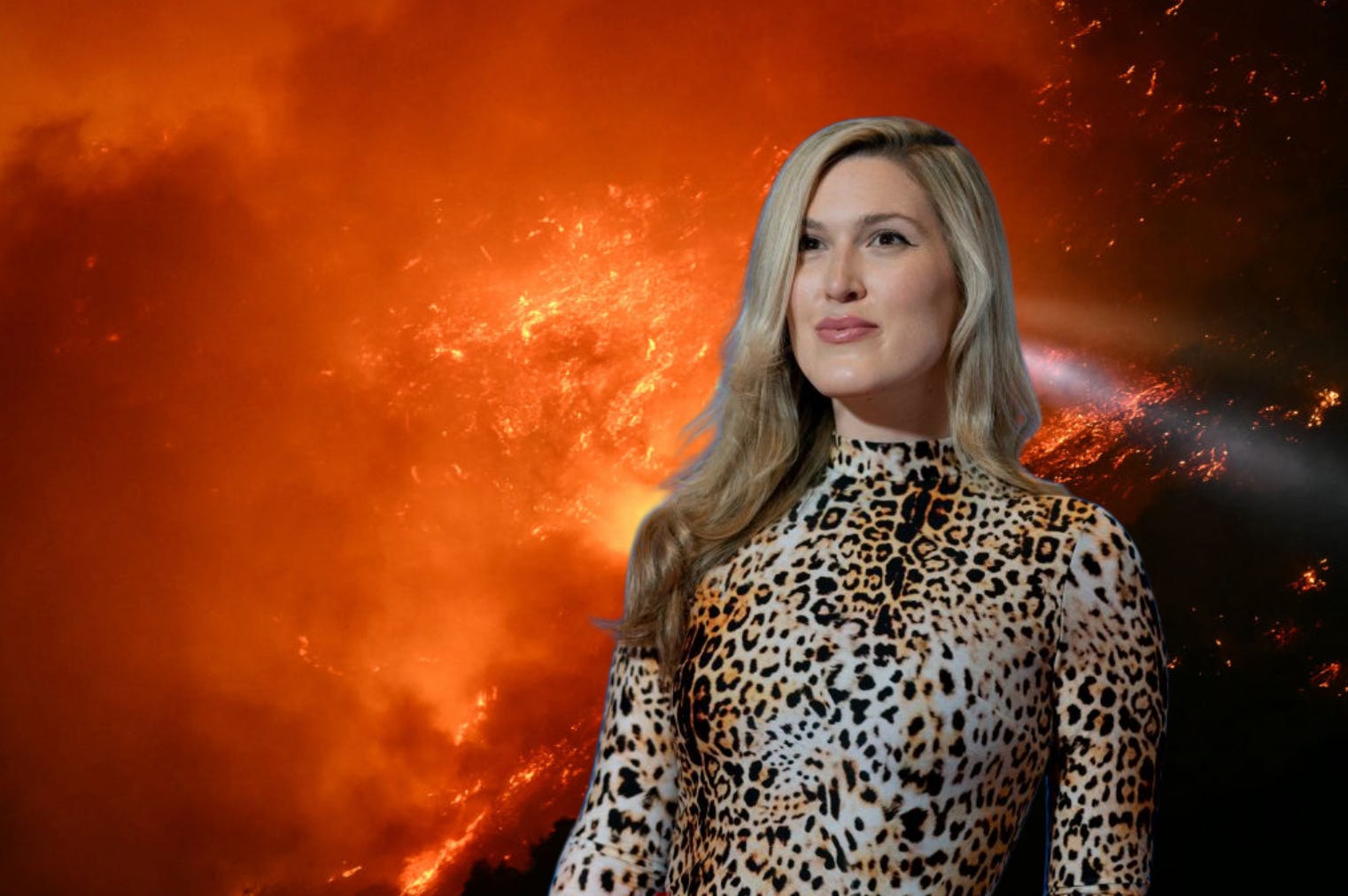
I’ve had my head down in a few long-term stories this week, but every time I come up for air, the internet is talking about Olivia Nuzzi, the former political reporter and newly-minted “West Coast editor” of Vanity Fair who had an “emotional affair” with Robert F. Kennedy Jr. while she was covering his presidential campaign.
Vanity Fair just dropped an exclusive excerpt of Nuzzi’s memoir, American Canto, detailing her relationship with the man who is now Secretary of Health and Human Services. There’s a lot to chew on: the brazen violation of basic journalistic ethics; the fact that Vanity Fair rewarded that violation by creating a new position for Nuzzi; and the funnier discourse over Nuzzi’s self-mythologizing prose.
But as I read through Nuzzi’s excerpt, I realized there was another aspect bothering me that I hadn’t yet seen discussed.
Throughout the excerpt, Nuzzi structures her narration around the Palisades fire, which devastated Pacific Palisades in January after the driest nine-month period on record. The fire was fueled by powerful Santa Ana winds and drought conditions that scientists say were made more likely and severe by climate change.
Nuzzi doesn’t mention that the fire killed 12 people, destroyed nearly 7,000 homes and other structures, or place over 180,000 people under evacuation order. Even when she brushes up against the human and economic toll, the fire ultimately serves mainly as a backdrop for her own relationship. With RFK Jr.
That’s what really turned my stomach: Nuzzi’s repeated use of climate-fueled wildfire as atmospheric mood lighting for her emotional affair with a man who helped bring a climate-denying administration into power.
The excerpt begins with Nuzzi standing near the Pacific Coast Highway, watching the blaze. “You cannot outrun your life on fire,” she says, pivoting straight into Kennedy’s repeated promise to “take a bullet” for her. Later, as “the wildfire is over my shoulder now,” Kennedy is across the country at an event with his wife. The relationship is rendered in fire language: “The spark, the flame, the rumor fulfilled. The labyrinth on fire. The Palisades fire.” The wildfire becomes a symbol for their relationship—its danger, its intensity, its eventual explosion.
Gross.
The crumbling of Nuzzi’s life and relationship is increasingly interspersed with fire timestamps: “12:40 a.m., 100 acres burning… 4 a.m., 1,800 acres burning… 9 a.m., 5,000 acres burning…” At one point, she describes the individual toll of a collective crisis: “What appears a cinematic apocalypse or dystopian war is, up close, a bunch of eyes stinging, lungs infected, lives disrupted, homeless displaced, memories destroyed, children terrorized, parents helpless and then distracted by calls to inept insurance companies.”
It’s a sharp line, but it still manages to land as tone-deaf. Because Nuzzi isn’t just writing about any random man under the orange sky. She’s writing about the literal Benedict Arnold of climate change—a man who sold out the planet for a slice of presidential power.
This may seem shocking for anyone who only started paying attention to Kennedy after he admitted to dumping a dead bear in Central Park (A scandal Nuzzi recently admitted to advising Kennedy’s presidential campaign on, among other issues). But before he aligned himself with Trump, Kennedy had spent decades building a following on being the climate guy. He waged lawsuits against polluters; called fossil fuels a “deadly addiction;” and warned that the carbon industry was waging war on a livable future. Over time, Kennedy drifted into conspiracism and anti-elite rhetoric, recasting himself as the outsider who thought the “climate establishment” was corrupt. But he still maintained the crisis was existential, even criticizing Trump’s climate policies in 2017.
Then, in 2024, Kennedy did the unthinkable: He endorsed Donald Trump, a candidate who’d spent his first term dismantling climate policy and expanding fossil fuels, and who promised to do the same again. It was obviously a catastrophic deal for the planet, but it was a great deal for Kennedy: He got a powerful perch as Trump’s Health and Human Services secretary—on the explicit condition that he would have no power over climate change and environmental issues, and allow Trump and his fossil-fuel allies to run energy and climate policy.
That’s what makes Nuzzi’s wildfire metaphor feel so vile. She uses the Palisades fire as a stand-in for everything she can’t control: the implosion of her life, her relationship, the country as a whole. It’s an old and almost understandable narrative instinct, treating a weather disaster as an act of God—a symbol of forces bigger than us, reminders that nature will always humble human beings.
But climate-fueled wildfires are not solely acts of God. They’re also acts of policy. Of course we can’t stop every spark or every wind gust, but we absolutely control how flammable the world is when those sparks fly: how much fossil fuel we burn, how hot and dry the West becomes, how and where we build, how seriously we take prevention and adaptation. Fires like Palisades don’t just happen to us; they’re intensified or restrained by decisions made by people in power.
It’s jarring to watch Nuzzi use a climate-driven fire as a symbol of helplessness in a story about the man who helped make the world more flammable—and then leave his role in that project entirely off the page. She reaches for wildfire to say, “Look how small I am in the face of this chaos,” while propping up a man who chose, very deliberately, to hand more power to a climate-denying president.
Climate disaster is not an act of God, and it’s not romantic ambiance. It’s the outcome of specific decisions, made by specific people, including the one Nuzzi calls “the Politician.” If you’re going to wrap your love story in fire, fine. At least be honest about who helped light the match.
Vanity Fair really appealing to the "vanity" in their name with Nuzzi's hire and their promotion of her memoir. It still doesn't seem as bad as Bari Weiss's elevation to a prominent role at CBS News, but it ranks up there.
Just disgusting, sad, and infuriating 😩