
Al Gore's case for optimism
Gore talks to HEATED about COP30, the Gates memo, and why he thinks billionaires should face far more scrutiny in the climate fight.

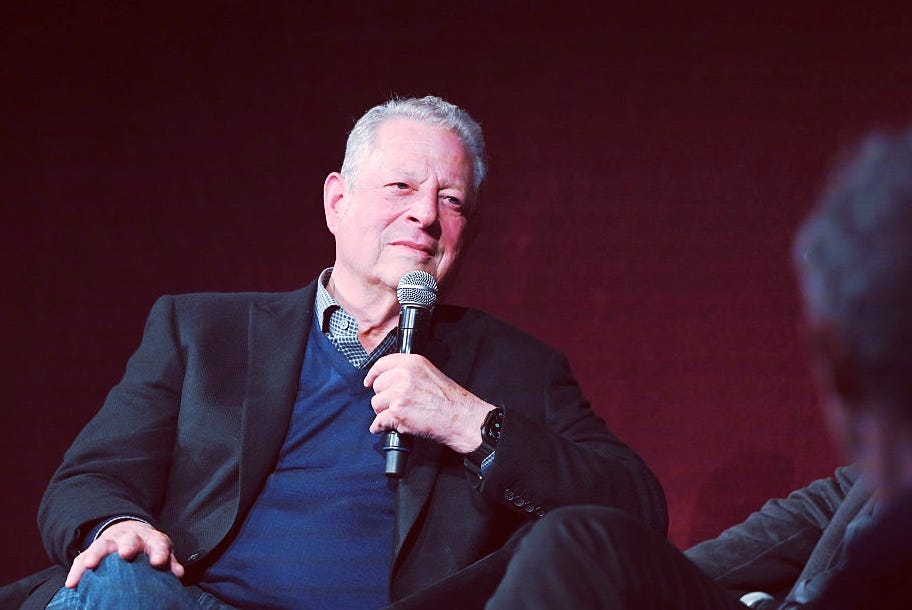
This year’s United Nations climate summit in Belém, Brazil had everything: A literal flood, a literal fire, a record-breaking 1,600+ fossil fuel lobbyists, and delegates from oil-producing nations working overtime to strip the final text of anything resembling a concrete commitment to stop lighting the planet on fire for profit.
So naturally, when I spoke to Al Gore on the final day of the summit, he was optimistic.
“[The fossil fuel industry] believes they are the global hegemon dictating policy for everyone else,” he said from his home office in Tennessee. “But I don’t think they are.”
Gore had returned from COP30 just a few days earlier, and insisted that what he’d seen on the ground was more encouraging than what doom-obsessed reporters like me were fixated on. “The majority of nations understand the crisis clearly, understand the cause clearly, and understand the solutions,” he said. “I wouldn’t bet against them.”
And yet, the final agreement that emerged seemed designed to test Gore’s faith. On the positive side, nearly every country on Earth—excluding the U.S., which did not send a delegation—agreed to new voluntary initiatives to accelerate national climate action. And more than 80 countries did back a roadmap away from fossil fuels, with South Korea pledging to stop building new coal plants and phase out existing ones.
But the final text didn’t even mention the words “fossil fuels,” much less include any timeline, mandate, or commitment to phase them out. Thanks to pushback from oil-producing nations, the final framework posed no real obstacle to continued fossil fuel expansion.
Gore acknowledged the deal’s shortfalls in a statement, calling it “the bare minimum of what the world must do.” But still, he argued that Big Oil’s victory at COP30 was largely symbolic. “Ultimately, petrostates, the fossil fuel industry, and their allies are losing power,” he said. “They may be able to veto diplomatic language, but they can’t veto real-world action.”
When we spoke, Gore walked me through the sources of his optimism. He also had a lot to say about Bill Gates’s controversial climate memo, and how it ties into a growing “global project to create a new autocratic world order“—one he believes is destined to fail.
Below is our full conversation, edited for length and clarity.
Emily Atkin: I am gonna be really honest with you. I have been struggling with how to write about COP30 in a way that’s going to connect with my readers. From what I’ve been hearing, they’re really exhausted. And then when they see another U.N. climate summit, they’re checking out. So I wanted to bring in the big guns. You’ve been at this for decades, you’ve watched these talks rise and fall. Why should they care about what has just happened at COP30?
Al Gore: The biggest danger humanity has ever faced is the climate crisis. We know the solution. We know fossil fuels are 80 percent of the cause. We have alternatives. Now is the time to set a rational course toward phasing them out. That’s why a roadmap is so essential.
We’ve reached a moment of important decisions. Saudi Arabia and OPEC, in league with Donald Trump and Vladimir Putin’s Russia, are attempting to make the fossil fuel industry hegemonic, dictating the world’s policies toward the principal cause of the climate crisis. They’re demanding to be in charge.
OPEC has attempted to capture this entire process. OPEC was the hidden hand behind the push to eliminate any mention of a roadmap to transition away from fossil fuels [in the COP30 text]. They even deleted the proposal to begin phasing out the ridiculous subsidies governments provide for fossil fuels.
The COP process must continue—and must be reformed—but the world needs texts that reflect reality, not the greed of the fossil fuel industry.
EA: COP30 had more fossil fuel lobbyists than any summit before it. Sometimes it feels like they really are in charge. Do you agree?
AG: I don’t think they are. But their attempt to fully capture the process raises, with new urgency, the need to reform this COP system.
We need these annual meetings. On a cumulative basis, they’ve added significantly to the momentum for change. Last year, 93 percent of all new electricity generation globally was renewable. In the U.S., it was 97 percent. Green tech spending has soared.
The COP process is meaningful—but it needs reform so the principal polluters are no longer in the driver’s seat.
EA: What else is fueling your optimism that the world will be able to effectively tackle climate change, despite the industry’s heavy hand and the rise of Donald Trump?
AG: The days off of Donald Trump directing policy in other countries are quickly coming to an end. He is now well and truly a lame duck. Members of his party are beginning to to trickle away from him, and I predict in the wake of the massive landslide election defeat [last month], more of them will pay less attention to his absurd demands.
Now, Trump is a dangerous lame duck, because he is flailing about with ever more extreme statements and proposals. But I think that this is a moment when the vast majority of nations who want to transition away from fossil fuels need to hold firm. A lot is at stake. He is losing power by the hour. And we have three years and two months to go, but we have to hold firm and stay on a rational course.
EA: I also want to ask you about the Bill Gates memo (the one where he downplayed the need to phase out fossil fuels and warned the world against “over-focusing” on climate change). You were one of the only people to question why Gates put that out. What do you think motivated him?
AG: I can’t see inside his mind or heart. But it struck me as more than a coincidence that he released the memo shortly after he went to sit next to Donald Trump at a White House dinner and lavished praise on him. He has a lot of irons in the fire with whoever is in power.
I don’t know his motives. I know he ended up with a position that was manifestly absurd. And I almost felt sorry for him that the same day he said “We have to choose between health and climate,” the Lancet Commission said the climate crisis is a principal cause of the health crisis, and the World Health Organization again reiterated that the climate crisis is the number one threat to to human health. Those are two of the most highly-respected health organizations in the world.
You know, I went back and looked to see if Gates has ever called for eliminating fossil fuel subsidies. I couldn’t find a time when he did that. He did offer in his book a few years ago an elaborate justification for subsidizing fossil fuels. And ironically, I did find his proposal for eliminating subsidies for renewable energy, even as he seems to favor continuing the subsidies for fossil fuels.
So again, I can’t judge what his motives are. But I think that there’s some evidence that he is frightened of Donald Trump. As soon as Trump was elected, he fired most of his climate staff, and then began to try and get on Donald Trump’s good side. And Donald Trump was the only person that gave his about-face on climate a rave review. And Gates waited five days to say that Trump had misread his position. Five days.
Again, these are just clues that can’t take the place of a genuine understanding of what on earth he was trying to accomplish. But I suspect that he’s scared of Donald Trump, and that he was bullied.
EA: It’s stuff like this that makes me skeptical of billionaire philanthropy as a climate solution. Because Gates was the climate philanthropist guy. At least that’s the perception of him among many of my readers. I’m wondering, do you think that billionaire philanthropy is speeding up or slowing down solutions?
AG: Well, I think that there is an alliance of convenience between the autocrats, the broligarchs, and the petrostates. And I think that, on the same day that OPEC was the hidden hand in writing this latest text for COP, Donald Trump presented a new plan for Ukraine in which it was obvious that the hidden hand writing it was Vladimir Putin. It was a detailed wish list of everything he wants. I think it underscores how there is a global project, now pursued by Trump and Putin and some of their broligarch and petrostate allies, to create a new autocratic world order.
Now, I don’t think they can do it. I think that they’re feeling their oats. But again, it’s ironic that, in this same period, we’ve passed peak Trump. The Supreme Court is clearly poised to limit his tariff authority. In the November elections, he suffered a landslide loss. He explicitly disclaimed his wack-a-doodle scheme for him getting a third term. And the maneuvering to replace him as the nominee as president in 2028 has begun in both parties. This is what happens when lame duck status is established.
And I guarantee you that the Republican members of the House and Senate have taken careful notice of the fact that the voters in the United States have had enough of this. And it’s impossible to predict what will happen in the elections a year from this month. But on average, historically, the party in the White House has lost 25 seats when they lose both New Jersey and Virginia in the odd year before the midterm elections.
So I think this autocratic wave that they’re trying to generate, to establish a new autocratic world order that extinguishes individual freedoms around the world, is destined to fail.
Here’s what they don’t understand. People love freedom. And we’re more resilient than he imagines. And the prospects of insulating our future against the horrific damage that fossil fuel pollution is doing is important to people around the world. I don’t think they’re going to be able to prevail in in their efforts.
EA: You’re presenting a clear case for optimism, and I appreciate that. But I think sometimes readers can take that as an excuse for complacency. Like, “Oh, cool, I can just sit back because it’s inevitable, the collapse of the autocracy is just gonna happen.” And I don’t think that that’s exactly right.
Is there just one useful political action that you think people should take to move this along?
Gore: Join the next No Kings Day protests around the country. It’s really building momentum. And when you see the massive swing in public opinion that was so vividly on display from [November’s election]—that should give people hope that the spell is being broken. Even some Trump supporters are asking themselves, “Is this really what I voted for?” Increasingly, they’re saying no. This is not the America we want. It’s not the America we believe in. We want to reclaim control of our destiny. I see that happening. Though I’ll admit that it’s a little like the scene in Das Boot where the bolts are popping.
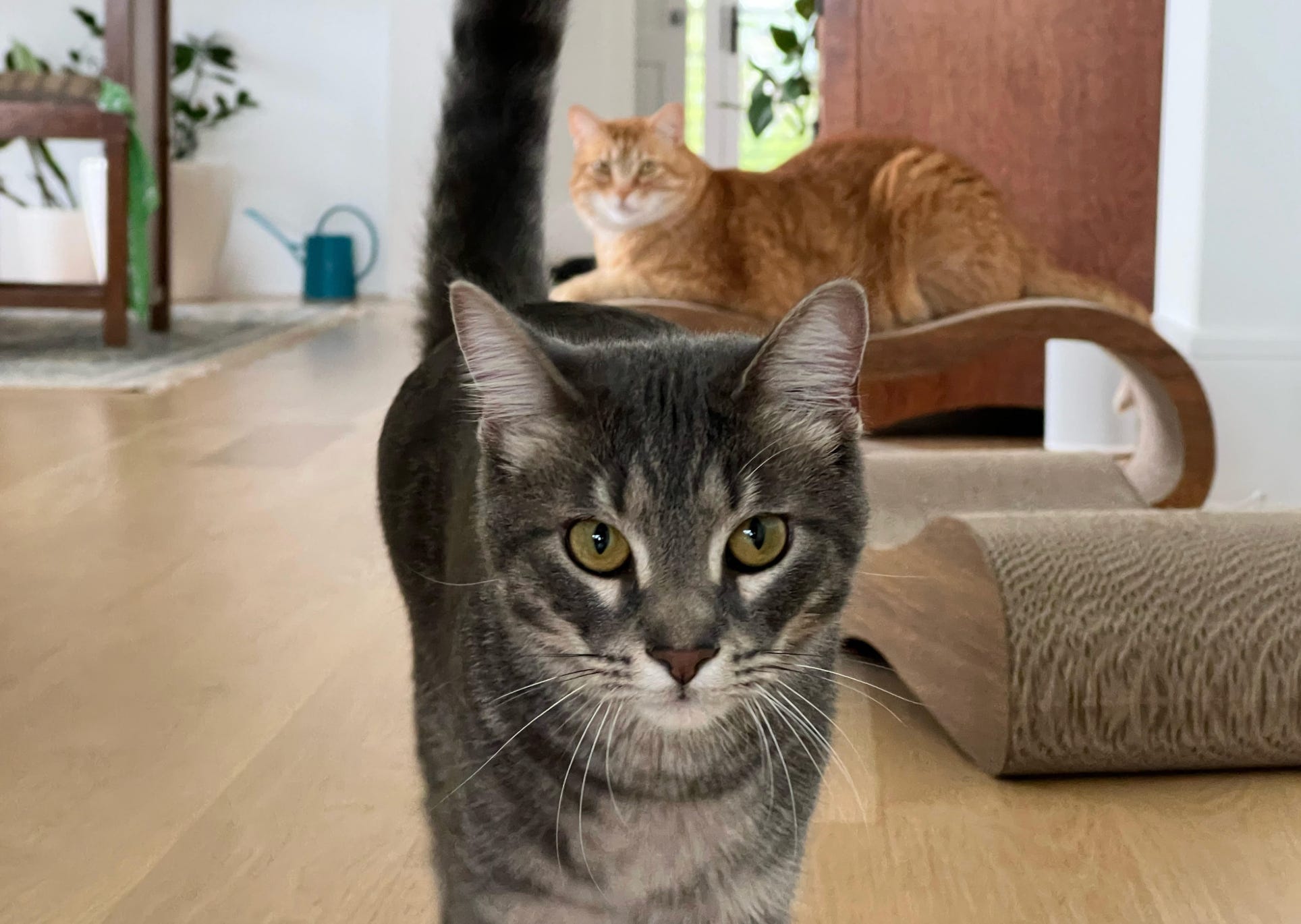
Catch of the Day: The handsome Mr. Jekyll (gray, foreground) would like everyone to know that his optimism is hanging on by a single toe bean, but hanging on nonetheless.
The elusive Dr. Evil (orange, background) declines to comment.
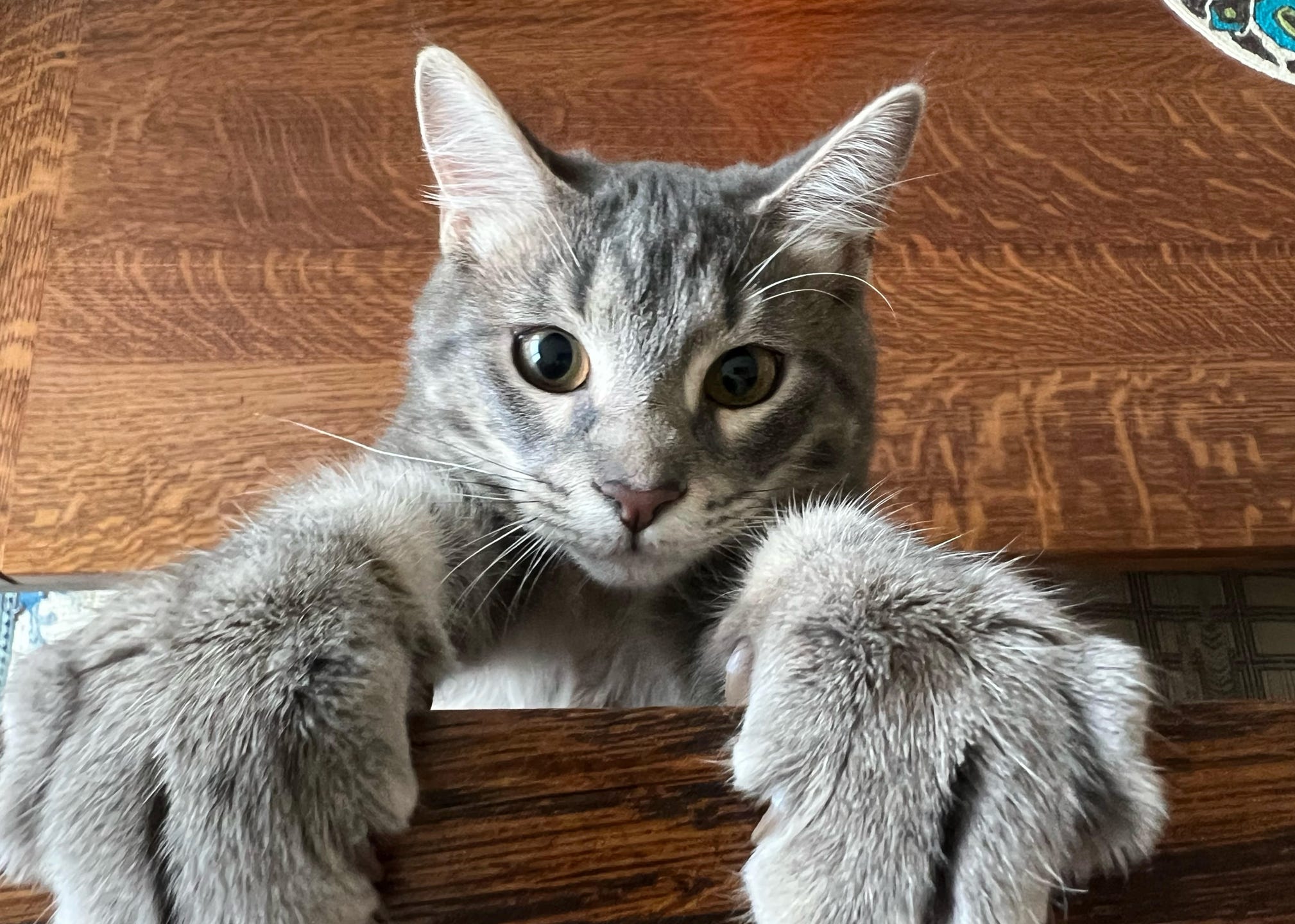
Thanks to reader (and much-appreciated HEATED source!) Dr. Katharine Hayhoe for the submission.
Want to see your furry (or non-furry!) friend in HEATED? Send a picture and some words to catchoftheday@heated.world.
Do I appreciate Al Gore's efforts to keep the public informed and optimistic about the prospects of mitigating the climate crisis? Sure. That said, at the end of the day, it's hard to be encouraged when the United States doesn't send a delegation and when the final product is a largely toothless agreement.
Maybe, as Gore says, the fossil fuel industry isn't the hegemonic power it thinks it is. It's still the elephant in the room, though.
People do love freedom, and it’s critical (if we are to preserve it) that we emphasize that the rule of law (which is under the same level of assault by the current regime as the climate) is the foundation of our freedom. Respect for law and objective truth must be emphasized whenever possible as we fight for effective climate action. Thank you (and Al Gore) for your excellent work on all fronts!