
Actually, I do know how to do this
In retrospect, paying attention to polluters may be one of the best ways to understand what’s currently happening in the United States.

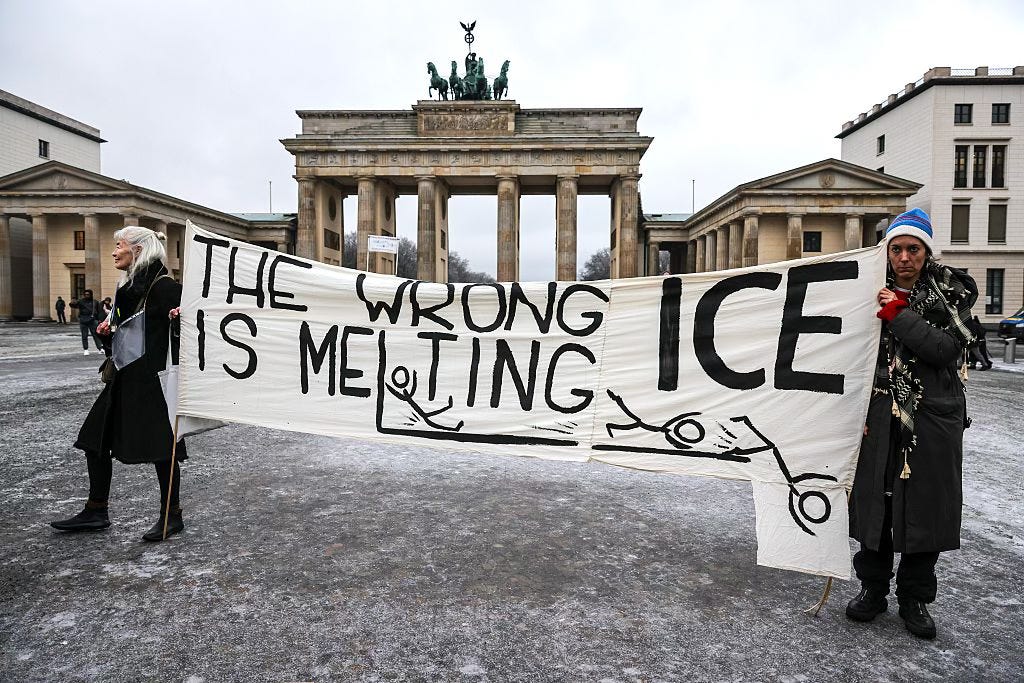
In last week’s newsletter, I struggled with a question: How are we supposed to keep caring about climate change while so much acute state violence is unfolding before our eyes?
I was able to eke out a few answers, and they seemed to really strike a chord with a lot of you. The post reached about 40 percent more readers than my pieces usually do, and many of you reached out to me directly, saying how helpful it was in motivating you to get back to climate and environmental work.
But a few days later, while preparing for an hour-long radio conversation about the piece, I realized something important: My original piece actually understated the case for keeping our eyes fixed on climate change, pollution, and the corporations fueling it during this political moment.
On further reflection, I think paying attention to polluters may be one of the best ways to understand what’s currently happening in the United States. Here are a few of the connections I didn’t fully spell out the first time.
Authoritarianism is fueled by fossil fuel dollars
I’m almost embarrassed to have not included this point in round one. Because the fact is, so many of the horrors we’re witnessing today were brought to us directly by Big Oil.
The fossil fuel industry was one of the largest corporate backers of Donald Trump’s return to power, giving at least $75 million to his campaign and affiliated PACs, and nearly $20 million to Trump’s inaugural fund. Oil and gas companies were also some of the biggest donors to Republicans in 2022 and 2024, helping secure the GOP majority in both houses.
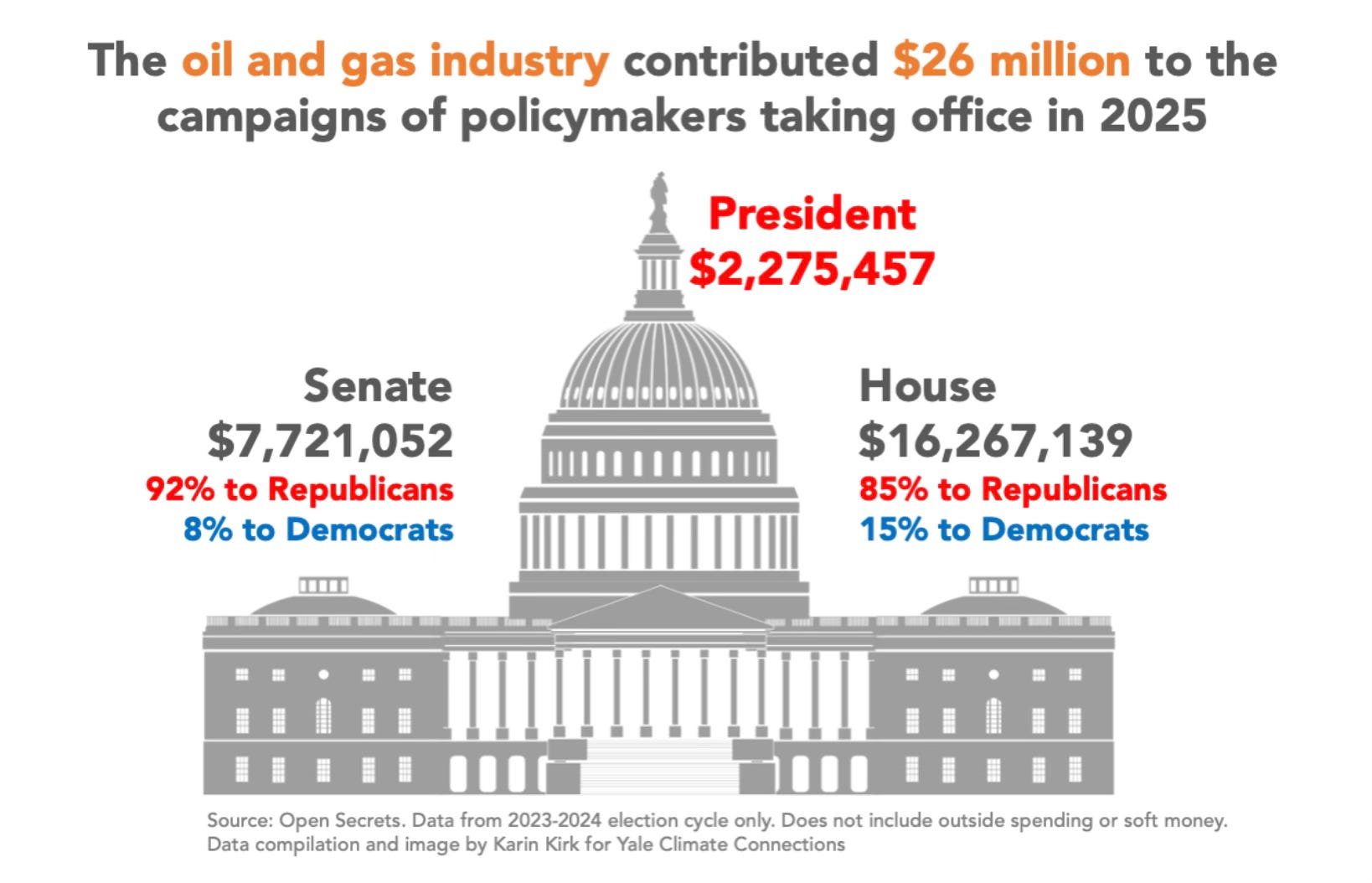
That money helped entrench a political movement openly hostile to democratic norms. This was not an accident. Authoritarians are better for fossil fuel business. If governments actually answered to the public, the transition away toward renewables would likely move much faster.
This is why the demand that climate activists “stay in their lane” has always rung hollow to me. The fossil fuel industry isn’t staying in its lane. It’s actively underwriting democratic decay.
Interestingly, research shows that countries become significantly more democratic when oil production starts to decline. So when we talk about transitioning toward renewable energy, we’re not just talking about a climate solution. We’re talking about a potential path toward healing democracy as well.
Democracy is climate infrastructure
Many climate groups already understand the point I just laid out above: you can’t regulate polluters in an authoritarian state. That’s why so many climate organizations, like the Climate Justice Alliance and Sunrise Movement, are now deeply engaged in showing up to anti-ICE protests.
E&E News reported earlier this month:
The youth-led climate organization the Sunrise Movement has been organizing “Wide Awake” protests outside hotels hosting Immigration and Customs Enforcement officials in the Minneapolis region. Noisy demonstrators wielding signs, makeshift drums and sometimes saxophones show up outside hotels between 11 p.m. and 4 a.m., hoping to make nights miserable for ICE agents and the hotels housing them.
Some people think these groups are abandoning climate goals by doing this. They’re not. They’re defending the conditions that make climate action possible.
Big Oil is funding anti-protest laws nationwide
The legal tools now being used to crack down on anti-ICE dissent didn’t appear out of nowhere. Many were built to protect fossil fuel interests.
After the 2016-2017 protests against the Dakota Access Pipeline at Standing Rock, oil and gas companies and their allies pushed state laws that sharply increased penalties for protests near “critical infrastructure” like pipelines and refineries. These laws were written broadly, expanding felony definitions and criminalizing actions as minor as being present near sites deemed essential. Today, they cover roughly 60 percent of U.S. oil and gas operations.
But these laws don’t stay confined to fossil fuel projects. Because “critical infrastructure” often includes transportation hubs, utilities, and government facilities, the same statutes can be used against other movements the state wants to suppress—including protests against immigration enforcement. The legal architecture designed to silence pipeline opponents is now part of a general crackdown on dissent.
This is why paying attention to polluters is essential in this moment. Fossil fuel companies didn’t just buy protection for pipelines. They helped build the framework now being used to narrow who gets to protest at all.
Environmentalists have long been called “domestic terrorists”
Trump administration officials have recently taken to using the language of “domestic terrorism” to describe people protesting immigration enforcement, including legal observers and journalists.
That tactic didn’t appear out of nowhere. In many cases, it was rehearsed on environmental movements.
I saw this up close while reporting in northern Minnesota during protests against the Enbridge Line 3 pipeline in 2021. Indigenous water protectors were surveilled, harassed, criminalized, and framed as threats to public safety. Law enforcement agencies used counterterrorism language to describe people trying to stop a pipeline from crossing treaty-protected land. We later found out that Enbridge had paid local police departments millions of dollars to carry out this repression.
This has happened before. During protests against the Dakota Access Pipeline , Indigenous water protectors were described as “insurgents” and “jihadists.” More recently, in 2023 and 2024, Georgia prosecutors charged protesters opposing the construction of a police training facility known as “Cop City” under the state’s domestic terrorism statute, including individuals accused of nonviolent acts.
Say it again: climate change is state violence
As Amitav Ghosh documents in The Nutmeg’s Curse, environmental destruction has long been used as a more palatable way to achieve the same ends as overt killing, by destroying the conditions people need to survive, and then calling the outcome inevitable or natural.
That logic is still with us. When an administration dismantles a climate or environmental regulation, it does so with a clear understanding of how many people that action is projected to kill. Every major rule comes with a cost-benefit analysis that explicitly tallies how many lives it is expected to save through fewer heart attacks, asthma deaths, premature births, and heat-related illnesses.
Rolling those rules back is a decision made knowing certain lives will no longer be saved. Which is why it matters that the EPA recently announced it would stop considering the value of human life in these analyses. You don’t remove that column unless you’re trying not to look at it.
Seen this way, the connections stop being theoretical. The same state willing to criminalize dissent, erode democratic safeguards, and look away from violence in the streets is also willing to let people die slowly through pollution and heat—as long as the right industries remain protected.
Another excellent article. Thank you! As a climate and democracy activist/organizer with Third Act Maryland, I have conversations all the time about whether it's more important to focus on climate or on democracy. I tell people fighting for the climate and fighting for democracy are really the same thing, and I point out that nothing pisses off Trump more than windmills and solar panels (with the possible exception of black and brown people standing up for their rights).
So we're working to pass state-level climate legislation, pressuring grid operator PJM, campaigning for redistricting, organizing Tesla Takedown rallies (still!), getting trained up to be ICE observers, organizing GOTV events, and on and on.
All are great points, but last connection is the strongest I think for helping myself and others understand the unique value of climate journalism in the current moment, precisely because it seems so unimportant and invisible.
Deaths due to lack of methane regulations or other EPA regulations or climate change itself still matter too. And if that doesn't get covered then I do think people forget about them. It is worth remembering that even things like asthma hospitalizations are not just a statistic but real people whose lives could be made better and there are people in power preventing that, just like they are preventing any accountability to ICE or making immigrant lives better.
All to say don't feel embarrassed, because it is all connected, and the work you do is awesome.