
He helped Microsoft build AI to help the climate. Then Microsoft sold it to Big Oil.
A former Microsoft product manager reveals how the tech giant is using AI to help Big Oil drill—and how he and his partner are now pushing for change.


Will Alpine had every reason to believe he was about to help save the planet.
The software engineer had just landed a job at Microsoft, the climate darling of the technology world. It was 2020, and months earlier, Microsoft made global headlines for its groundbreaking new commitment to not only become carbon negative by 2030, but to remove from the atmosphere all the climate pollution the company had ever emitted since its 1975 inception by the year 2050.
Will saw his new role at Microsoft as a way to help fulfill that pledge, and create a climate-friendly model for the rest of Big Tech. As a product manager working on the company’s artificial intelligence platform, he was tasked with developing tools to make it easier for customers to use Microsoft’s AI in an ethical and environmentally sustainable way.
“I thought it was just the most exciting thing in the world, building the cutting-edge tools and technology that could really help fight climate change,” he recalled. Both Will and Microsoft were adamant that this was the future of AI: to help society transition toward a cleaner, greener economy.
Will poured himself into the job. He created a group called Green AI, dedicated to reducing the carbon footprint of Microsoft’s AI development and operation. He helped build the CarbonAware SDK, a tool that enables software programs to perform larger processing tasks when electricity is coming from low-carbon sources, and smaller tasks when electricity is coming from fossil fuels. He met his now-wife, Holly Alpine, who was organizing nearly 10,000 Microsoft employees into a community to incorporate sustainability into their jobs.
“I'd say for about a year, year and a half, we were heads down doing good sustainability work,” he said. “Only then did I start to realize who was really using the AI that I was helping build.”
“Our paychecks were dripping in oil”
Holly, then a senior manager at Microsoft, first learned her employer was selling AI to Big Oil about a year before Will arrived. “It was this really secretive thing,” she recalls.
In 2019, a high-level employee who worked on climate told Holly about several contracts Microsoft had to help fossil fuel companies increase their production. These companies, she learned, were using Microsoft cloud computing to process seismic data, and then using Microsoft machine learning algorithms and AI to analyze that data, telling them where to drill.
One contract with ExxonMobil was going to help boost production in Texas and New Mexico by up to 50,000 barrels per day. Another deal with Chevron would use Microsoft AI to “dramatically accelerate the speed with which we can analyze data to generate new exploration opportunities.”
Word spread, and employees grew concerned that Microsoft was massively undermining its own climate efforts. After all, enabling Exxon to produce 50,000 more barrels of oil per day meant Exxon would produce 18.25 million more barrels of oil per year. That meant Exxon would release 6.4 million metric tons of carbon into the atmosphere per year—all because of Microsoft’s technology. (Microsoft had pledged to remove 1 million metric tons of carbon per year).
So in September 2019, employees confronted leadership in a company town hall meeting. In a transcript manually recorded by employees present at the time, Microsoft CEO Satya Nadella defended the deals, saying he believed that working with oil companies would ultimately help them transition to clean energy. “Give them that productivity boost so they can help themselves and help the world,” Nadella said. (HEATED did not obtain the transcripts from any named source in this story).
At another town hall in October, Nadella was pressed on the oil partnerships again. He was again adamant that Microsoft’s partnerships would help oil companies eventually transition away from fossil fuels.
“If we stop engagement, what’s the benefit? Who benefits? Nobody benefits,” Nadella said. “It’s not as if you can stop producing oil tomorrow, because the world would stop. The question is, how can we contribute to an energy transition plan?”
A few months later, Microsoft announced its aggressive climate goals—and employees were hopeful that this would be the end of oil partnerships. After all, Microsoft’s biggest competitor, Google, had just announced it would stop making AI tools for the oil and gas industry. Perhaps with its new climate goals, Microsoft would follow suit.
“We do not wish to be made complicit”
Will learned about Microsoft’s work with oil companies shortly after joining the company. But he was hopeful—resolute, even—that these contracts would not represent the future of AI.
To ensure that the technology would be used for positive planetary change, Will co-authored a white paper called “Accelerating Sustainability with AI,” which laid out all the climate-positive ways Microsoft’s AI toolkit could be used by third parties. He imagined the biggest customers would be renewable energy companies, low-carbon materials makers, and emergency managers.
In 2020 and 2021, however, Microsoft announced several new partnerships with oil companies designed to help boost production. At that point, the company had become the number one cloud provider for the fossil fuel industry.
So Holly and Will—who’d met serendipitously on a mountain in 2020—sprang into action. In 2021, they sent an 8-page memo to Microsoft’s leadership, alerting them of the profound climate impact of the company’s fossil fuel contracts.

“The math is clear: many of our deals entirely negate our company’s emissions goals,” they wrote. In addition, Will and Holly noted that none of the 50 oil and gas companies Microsoft was working with publicly claimed to use Microsoft’s AI or cloud computing technology to transition away from fossil fuels, as Nadella had argued.
In fact, it was just the opposite. BP was using Microsoft AI technology to “invest in more oil and gas;” Chevron was using it for “new unconventional [fracking] wells,” and Exxon was using it to “improve exploration success.”
“Such clearly stated strategies are alarming in that they make Microsoft’s claims of enabling the transition to a clean economy materially misleading to both shareholders and employees,” they wrote. “We do not wish to be made complicit.”
A meeting with Microsoft’s leadership
In the memo, Will and Holly listed more than a dozen recommendations to help Microsoft align its AI business with its climate goals. Soon after, they presented those recommendations to Microsoft President Brad Smith and then-chief-environmental officer Lucas Joppa in and in-person meeting in December 2021.
Notably, Holly and Will didn’t recommend the company stop working with the fossil fuel industry entirely. Instead, they said Microsoft should “establish a principled approach” with oil and gas customers, and “account for the carbon impacts” the company’s technology enables. They also said the company should amend its Responsible AI Principles to include environmental impact.
“They agreed with us on almost all of the recommendations,” Holly recalled. “They made some promises to us, and we tried to work with them over the course of the next few years to ensure that those were fulfilled.”
But ultimately, Holly and Will say almost none of the promises made by leadership came to pass. Microsoft did eventually release a set of “energy principles” guiding its work with oil companies, but these only required that oil companies make a public commitment to reach net zero by 2050 if they wanted to work with Microsoft. They did not require oil and gas companies to include Scope 3 emissions in those goals, nor did they require oil companies to actually meet their net zero goals.
Notably, four years later, Microsoft’s Responsible AI principles still don’t include environmental impact.
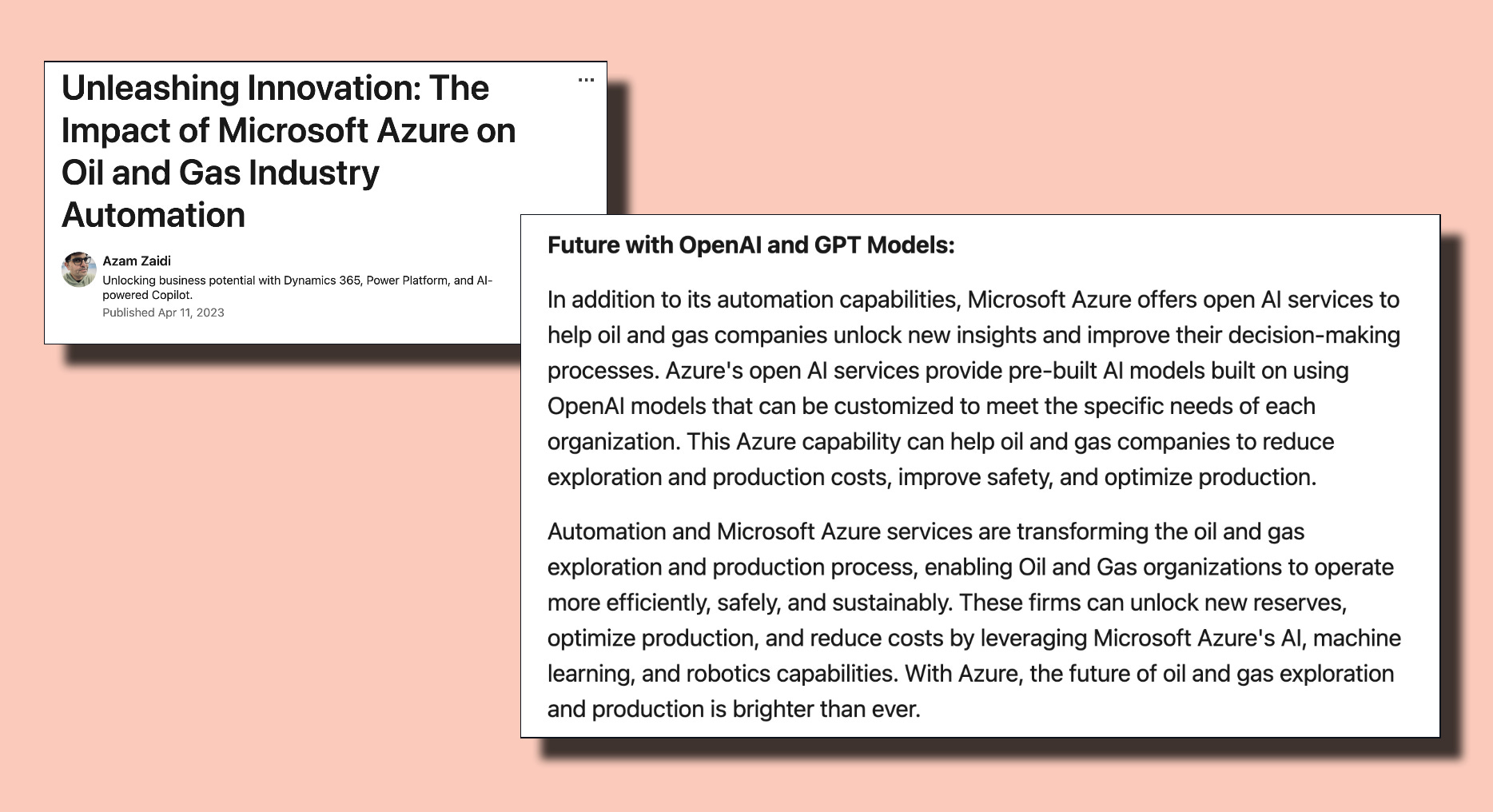
For Holly, the final nail in the coffin was seeing a now-deleted LinkedIn post from Microsoft technical architect Azam Zaidi, which gushed over the company’s role in increasing fossil fuel production.
“These firms can unlock new reserves, optimize production, and reduce costs by leveraging Microsoft Azure's AI, machine learning, and robotics capabilities,” Zaidi wrote. “With Azure, the future of oil and gas exploration and production is brighter than ever.”
Drilling for oil is “one of the biggest use cases of AI today”
From the years Will and Holly spent trying to change Microsoft from the inside, they came to some painful realizations.
For Will, he came to believe that Microsoft was using his work on the climate-positive potential of AI to distract from the actual, systemic climate harms the company was enabling.
“From what I saw, I believe that finding and extracting more oil is one of the biggest use cases of AI today,” he said. He said he tried to find examples of customers using the climate-friendly AI tools he was making, but “it’s very difficult to find them, or at least ones that were operating at any significant scale.”
Holly said she was most surprised at Microsoft’s capacity for massive hypocrisy on climate. “We kept thinking we must be missing something,” she said. “But the more contracts we saw, the more we realized there’s just a part of Microsoft that just wants to make money, and this is where the money is, with no guardrails or accountability mechanisms in place.”
Another tough square to circle was that Microsoft is, in fact, doing a lot of “world-changing” things for the climate, as Holly described it. “I would not say it’s purely a propaganda machine,” she said. For example, the company’s massive investments in renewable energy and “unsexy projects like upgrading transmission lines” are impossible to ignore, she said.
“We just think you need to also address the other side of the equation,” she said. “You cannot only count one team's points when you're playing a game of basketball.”
And if Microsoft were playing a game of basketball wherein the benefits of their pro-climate actions were scored against the harms of their fossil fuel contracts, Will and Holly are confident which side would prevail.
Microsoft’s response
I reached out to Microsoft for comment after my interview with Will and Holly. I imagined that the company would want to respond to the pair’s allegations, and explain how its work with fossil fuel companies aligns with its climate goals.
Following a brief logistical discussion with spokesperson Kendra Folks—I explained the story and asked for a phone interview, she offered to respond to e-mail questions—I sent over a bullet-pointed list summarizing Holly and Will’s most significant claims about the company.
In addition, I sent some questions of my own. Most importantly, I wanted to know: Does Microsoft have any evidence that its work with fossil fuel companies is helping the industry decarbonize?
A few days later, I received my response.
“Microsoft has nothing to share.”
Turning angst into activism
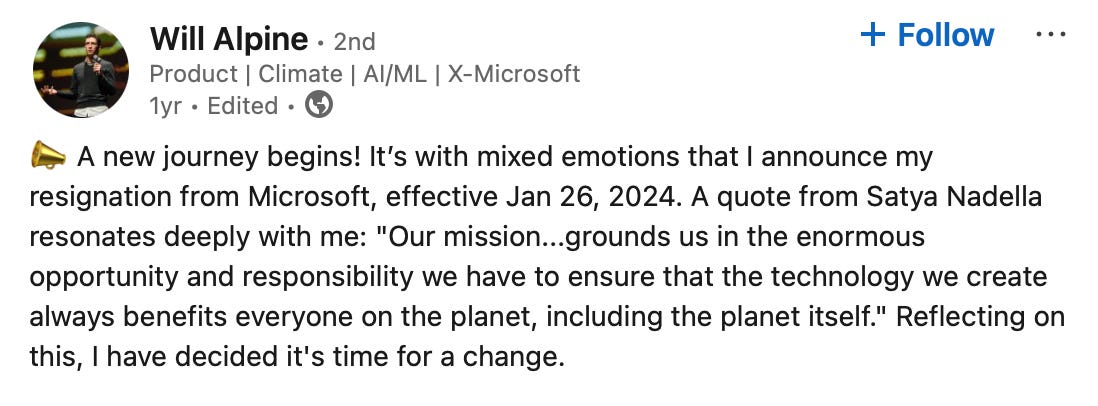
The decision to quit Microsoft was painful for both Will and Holly, both financially and emotionally. “It was my dream job,” Holly said. “That’s why it was so devastating to learn that our paychecks were dripping in oil.”
The choice ultimately came down to where the pair believed they’d be able to make the most change. And after years of pushing Microsoft from the inside, they felt they’d reached a dead end.
They also realized that there was no outside activist group dedicated to holding Big Tech accountable for the climate impact of their work with fossil fuel companies. So after quitting in January 2024, they created Enabled Emissions.
Holly sees Enabled Emissions as complementary to groups like No Tech for Apartheid, which calls attention to Google and Amazon’s $1.2 billion AI and cloud computing contract with the Israeli military.
“You don't get to call yourself the company of peace if you’re the number one cloud provider for Lockheed Martin,” she said. “And you don’t get to call yourself the company of climate action if you’re the number one cloud provider for the fossil fuel industry.”
One of Enabled Emissions’s goals is simply building awareness. Most people know about the direct environmental footprint of AI through data centers’ energy and water use. But AI’s “deliberate role helping oil companies significantly increase fossil fuel expansion—with staggering emissions—remains largely unaddressed,” the website reads.
Another goal is to put external pressure on Microsoft via bringing shareholder resolutions; encouraging Microsoft’s biggest customers to bring up the issue; and perhaps, in the future, organizing direct actions.
“It’s one of the hardest things we’ve ever done,” Will said. “But we would do it all over again.”
Correction: A previous version of this story misstated Will’s role at Microsoft. He was a product manager, not project manager.
P.S. — Will did a great 5-minute TED-style talk at Ignite Seattle earlier this year. I recommend giving it a watch.
P.P.S — Here’s some more info I couldn’t fit in the piece:
No Catch of the Day today; e-mail length limit won’t allow it. We’ll be back in your inbox with pet pics soon!
Want to see your furry (or non-furry!) friend in HEATED? Send a picture and some words to catchoftheday@heated.world.
This is a fantastic piece of reporting and writing
I agree. This is good reporting. We need to keep up the hammering any way we can. Little chips can turn into cracks if we keep hitting the same places over and over again.
This also exposes how money is the god they all pray to and money is all that matters. I guess they figure, screw the next generations. take all of the money they can get now and not worry about the future beyond their own life spans.
Keep chipping away young lady and us oldsters will keep supporting your work as best as we can.