
Everlane was never eco-friendly
Everlane helped sell the idea that buying lots of new clothes could be good for the climate. Now that marketing belongs to Shein.

HEATED is 100 percent funded by paid subscribers. Become one ⬇️
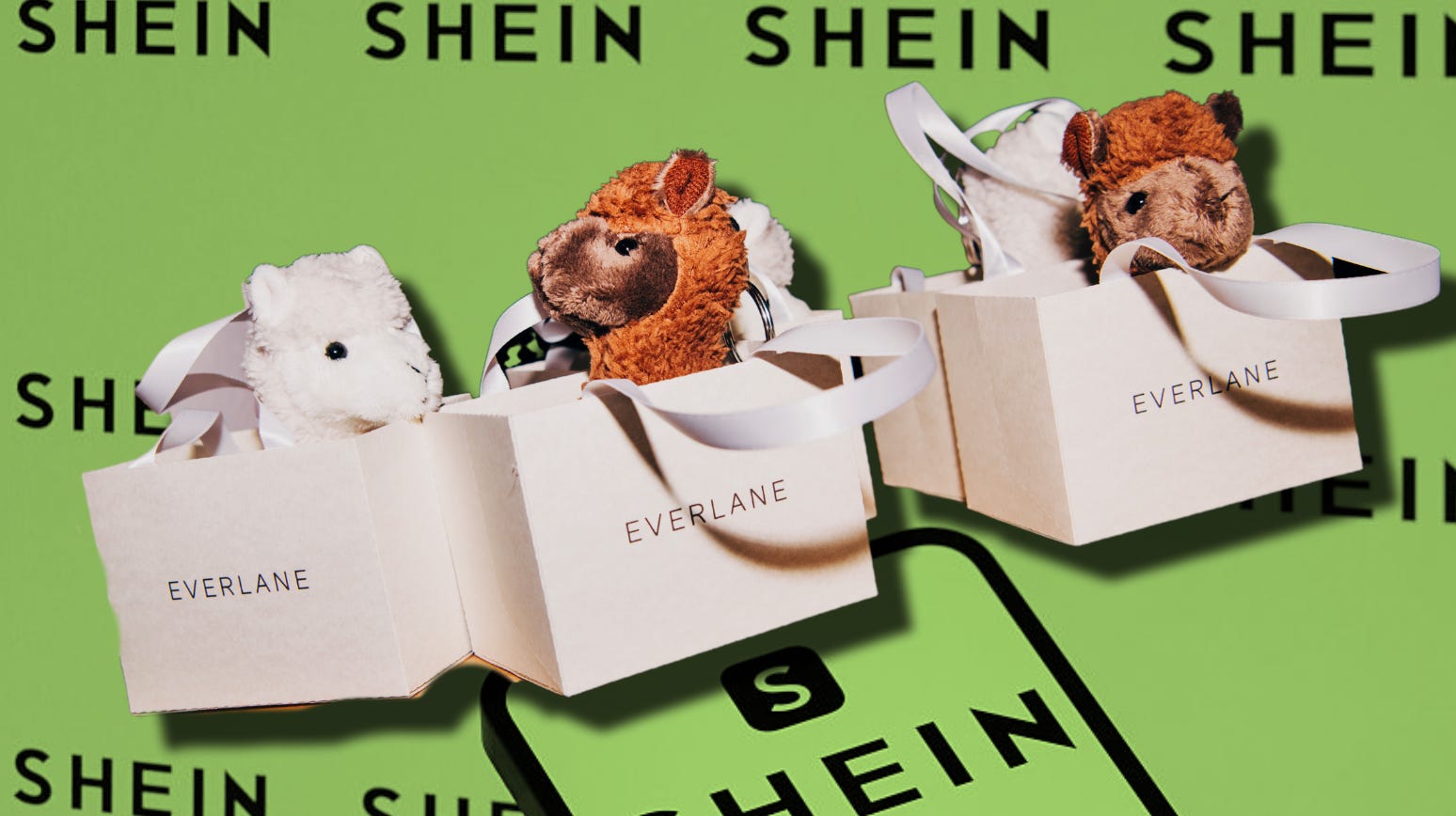
Big news on the “green capitalism” front: Everlane, the much-beloved clothing brand built on a promise to make fashion climate-friendly, is being purchased by Shein, the most-polluting fast fashion brand on Earth.
The prevailing public reaction to this sale (valued at $100 million, first reported by Puck News) has been shock and disappointment that such an ethical, sustainable brand would sell out to such a massive planetary ghoul.
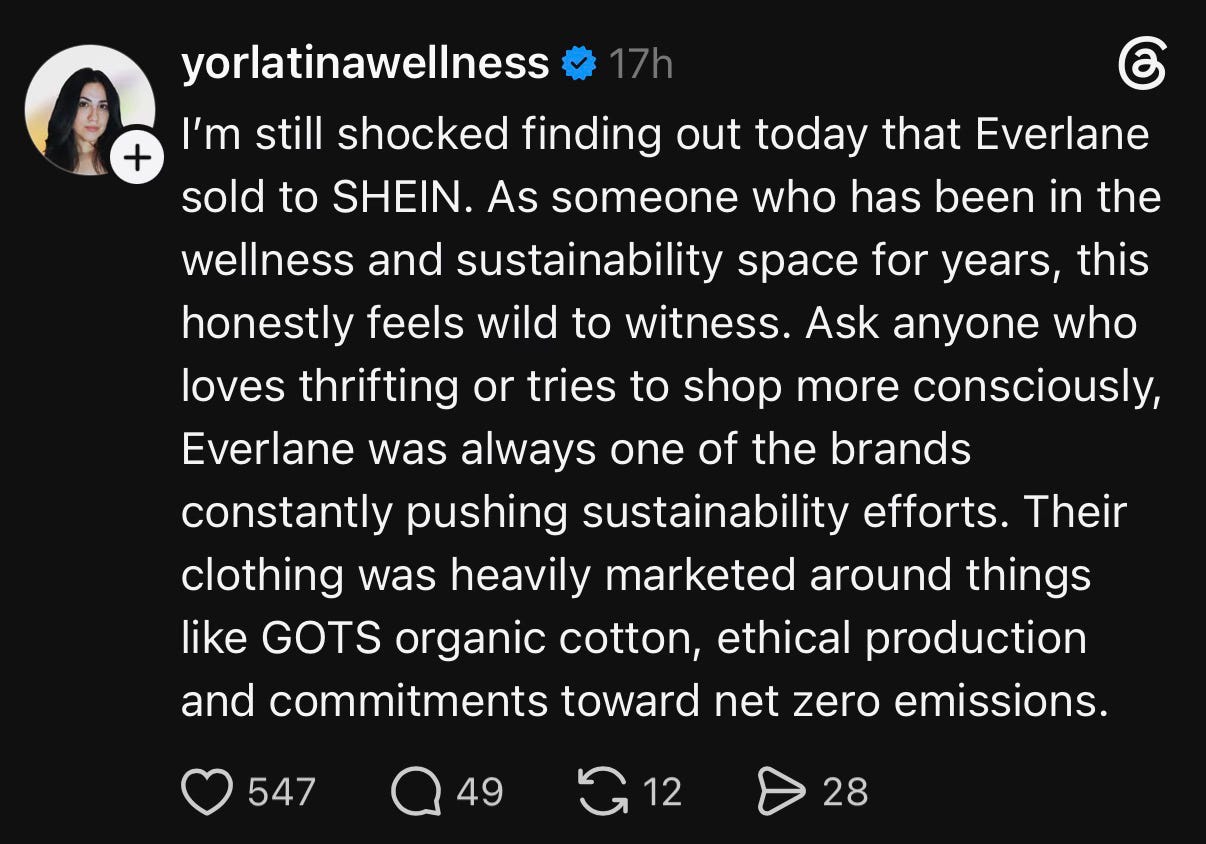
But I’m here to tell you that Everlane was never actually “good” for the planet. It was, however, really good at selling the idea that buying lots of new clothes could be sustainable. And that’s what Shein is actually buying: not an eco-friendly company, but an eco-friendly image.
The good Everlane has done
Now look: I’m not saying Everlane’s entire pro-Earth marketing strategy was a lie. By the dismal standards of the fashion industry, the company has done quite a lot to reduce emissions, water use, and virgin fossil fuel materials.
A 2020 Stanford Business profile of Everlane founder and then-CEO Michael Preysman noted that the company waited six years to make its first pair of jeans because it wanted to wait for a manufacturer that could recycle 98 percent of the water used in production. It also noted that Preysman had committed in 2018 to removing all virgin plastic from the company’s supply chain, stores, and offices by 2021.
By 2022, Everlane was publicly describing its work around three goals: “Keeping Earth Clean,” “Keeping Earth Cool,” and “Doing Right By People.” The company also began publishing impact reports and setting climate targets. Everlane says its carbon goals are aligned with a 1.5°C pathway: cutting per-product emissions 55 percent by 2030, reducing absolute emissions from stores and headquarters 46 percent by 2030, and reaching net zero by 2050 or sooner.
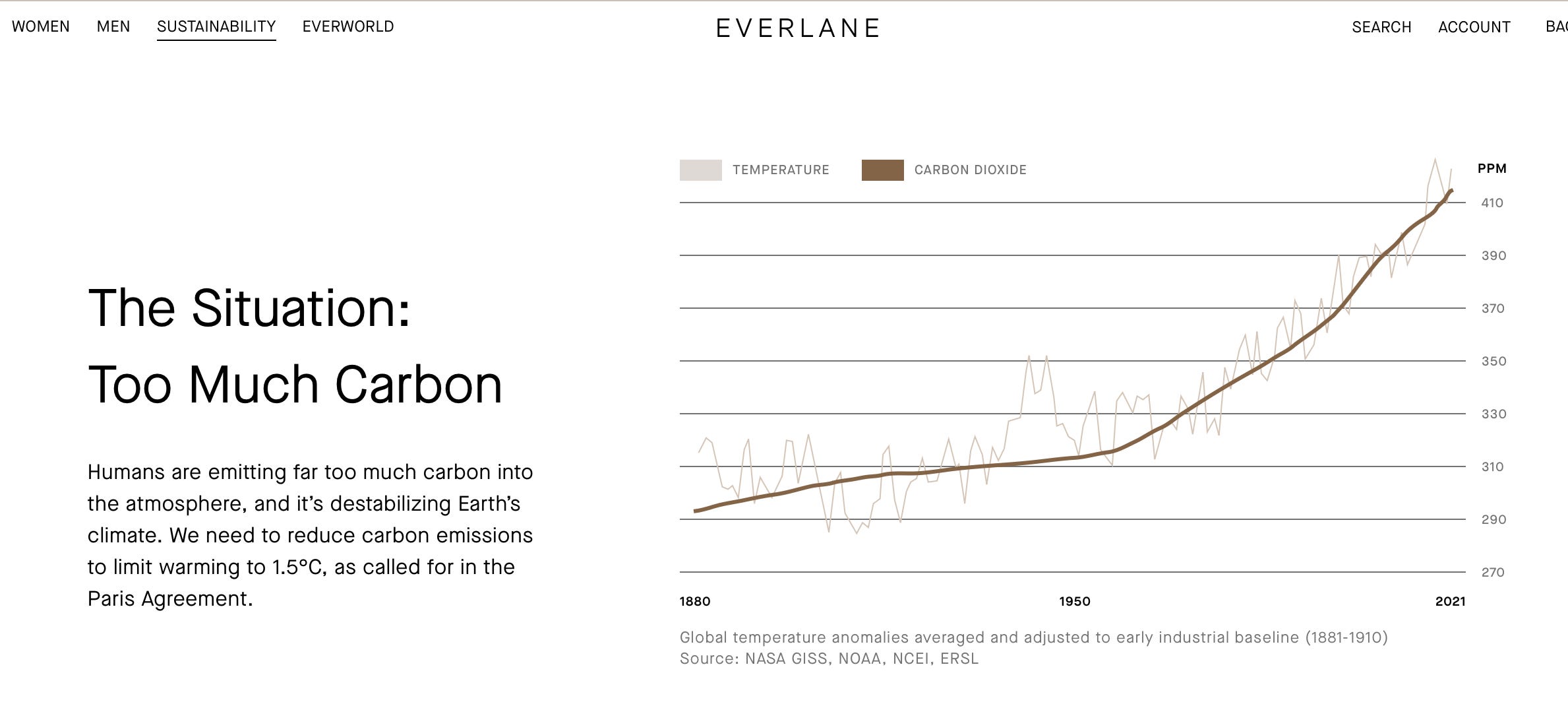
By 2025, Everlane claimed to have already achieved a 42 percent reduction in per-product emissions and cut absolute Scope 1–3 emissions 60 percent below its 2019 baseline calculation. Trellis reported that 90 percent of Everlane’s materials in 2024 met “lower-impact” standards, such as being organic, recycled, or “responsibly sourced.”
The work seemed to be continuing up until Everlane’s acquisition by Shein. Last year, Everlane announced it would co-invest in textile mill decarbonization projects alongside two other sustainable fashion brans, Reformation and Eileen Fisher. (I reached out to the Apparel Impact Institute, the group coordinating the investments, to see if Everlane’s contributions would continue under Shein’s ownership. No word back on that yet).
So yes: Everlane made real efforts to reduce harm, measure emissions, improve materials, clean up parts of its supply chain, and talk about fashion’s environmental impact in ways most apparel brands did not. (The company also did some notable pro-climate media partnerships with The New York Times and The Atlantic).
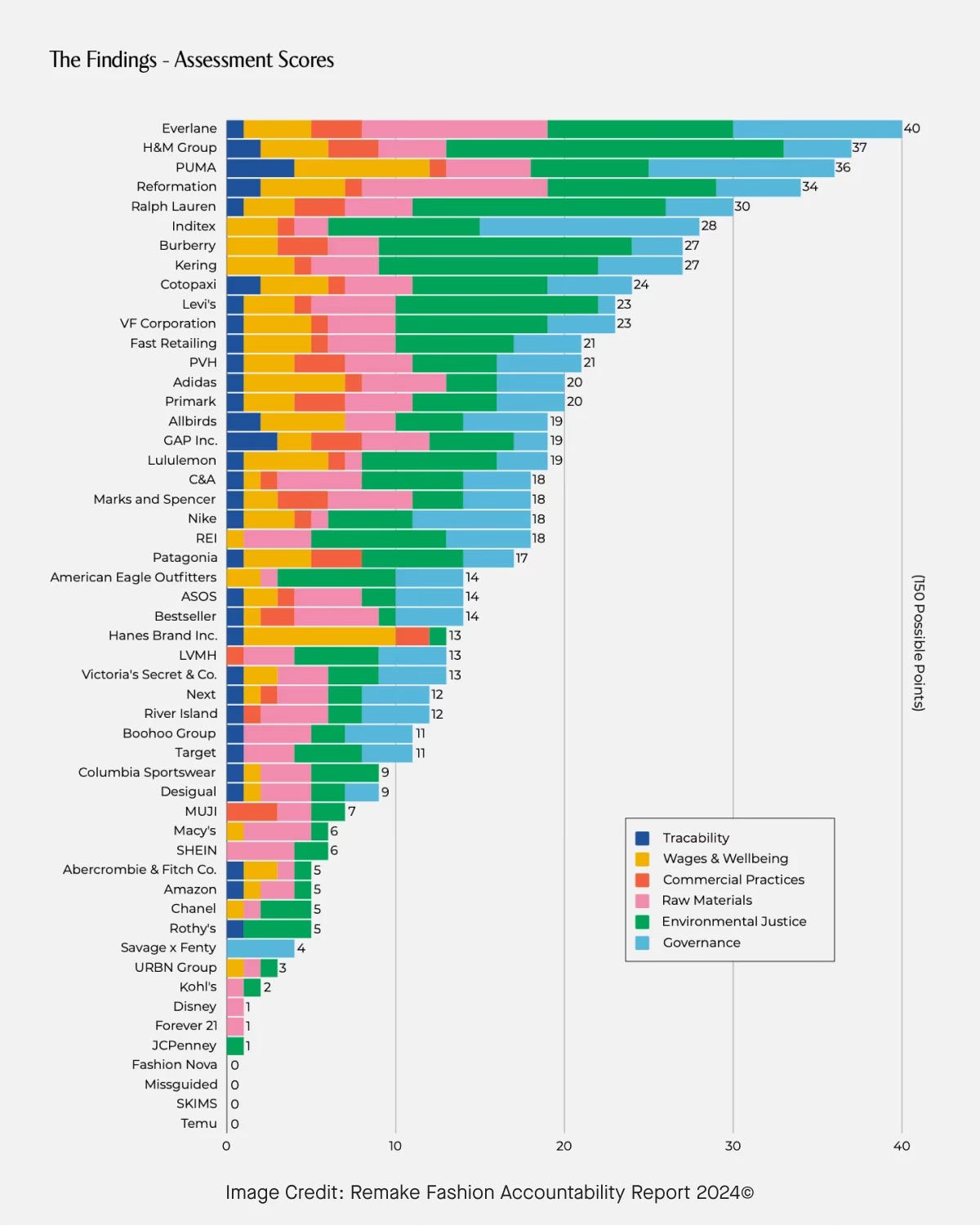
But reducing harm to the planet is not the same thing as being good for the planet. And that distinction matters, because the fashion industry’s climate problem is not merely that too many clothes are made badly. It’s that too many clothes are made, period.
Everlane’s DTC business model relies on overconsumption
Everlane is nowhere near Shein-style ultra-fast fashion. But it’s still a major fashion company whose direct-to-consumer business model relies on a basic formula: keep selling people new clothes, in new colors, in new patterns, in new shapes, in perpetuity.
That cycle of overconsumption is fundamentally incompatible with a safe climate. The United Nations Environment Program’s 2024 Global Resources Outlook found that resource extraction and processing account for more than 60 percent of climate warming emissions, and that global resource use has more than tripled since 1970—from 30 billion tonnes to 106 billion tonnes. Without urgent action, UNEP warned, material extraction could rise another 60 percent by 2060.
Fashion is a major expression of that crisis, responsible for up to 10 percent of global carbon emissions. The Ellen MacArthur Foundation found that clothing production approximately doubled over 15 years, while clothing use fell by almost 40 percent. In the United States, landfills received 11.3 million tons of solid waste textiles in 2018, equal to 7.7 percent of all landfilled municipal solid waste.
In order for a fashion company to be truly climate-friendly, it would have to make and sell fewer clothes. And that’s the contradiction every “sustainable” fashion brand eventually runs into: To actually be good for the planet, it must discourage overconsumption. But to survive, it usually has to encourage it.
That is why Everlane could never truly be climate-friendly. Its individual practices may have reduced harm, but its business model still always depended on accumulating more stuff. In fact, there is probably a real case to be made that the company’s focus on making better quality products was part of the reason it wasn’t able to sustain itself. After all, you have to keep selling shit to stay in business. Obviously, Everlane was no longer selling enough shit.
But that’s also what makes Shein’s acquisition of Everlane so alarming. It’s not so much that Everlane “sold out.” It’s that Shein has bought the exact kind of brand it needs to launder its genuinely ecocidal business model.
Because Shein is not burdened by any true desire to slow the cycle of resource extraction. Shein is the final boss of overconsumption: a company whose entire model is built on producing and selling a staggering volume of cheap clothes, as quickly as possible, to as many people as possible.
So I am willing to bet a large sum of money that Shein is going to use Everlane to greenwash itself. Everlane, as Startup Fortune reported, “helped define the language of clean design and ethical sourcing for a generation of digitally native shoppers.”
Now that language belongs to Shein. It’s our job not to fall for the lie.
I teach sustainable fashion as part of a sustainable business course and you've hit the nail on the head here with the paradox of selling more and the green imperative of selling less. I find degrowth a useful model here: reduce planet-harming sectors as much as possible (fast fashion), decommodify as well (more self-made clothes, swaps), reuse what's there (secondhand), and make sure that the new stuff produced doesn't harm the planet or exploit humans or animals and lasts as long as possible (slow fashion). This post made me a subscriber!
"And that’s the contradiction every 'sustainable' fashion brand eventually runs into: To actually be good for the planet, it must discourage overconsumption. But to survive, it usually has to encourage it."
Noting this contradiction full well, is there a model by which a "sustainable" fashion brand *could* exist without compromising on that dimension? It feels like either you stay small, violate that premise, or go big and eventually fold. It sounds silly to ask, but is there a sustainably sustainable solution?