

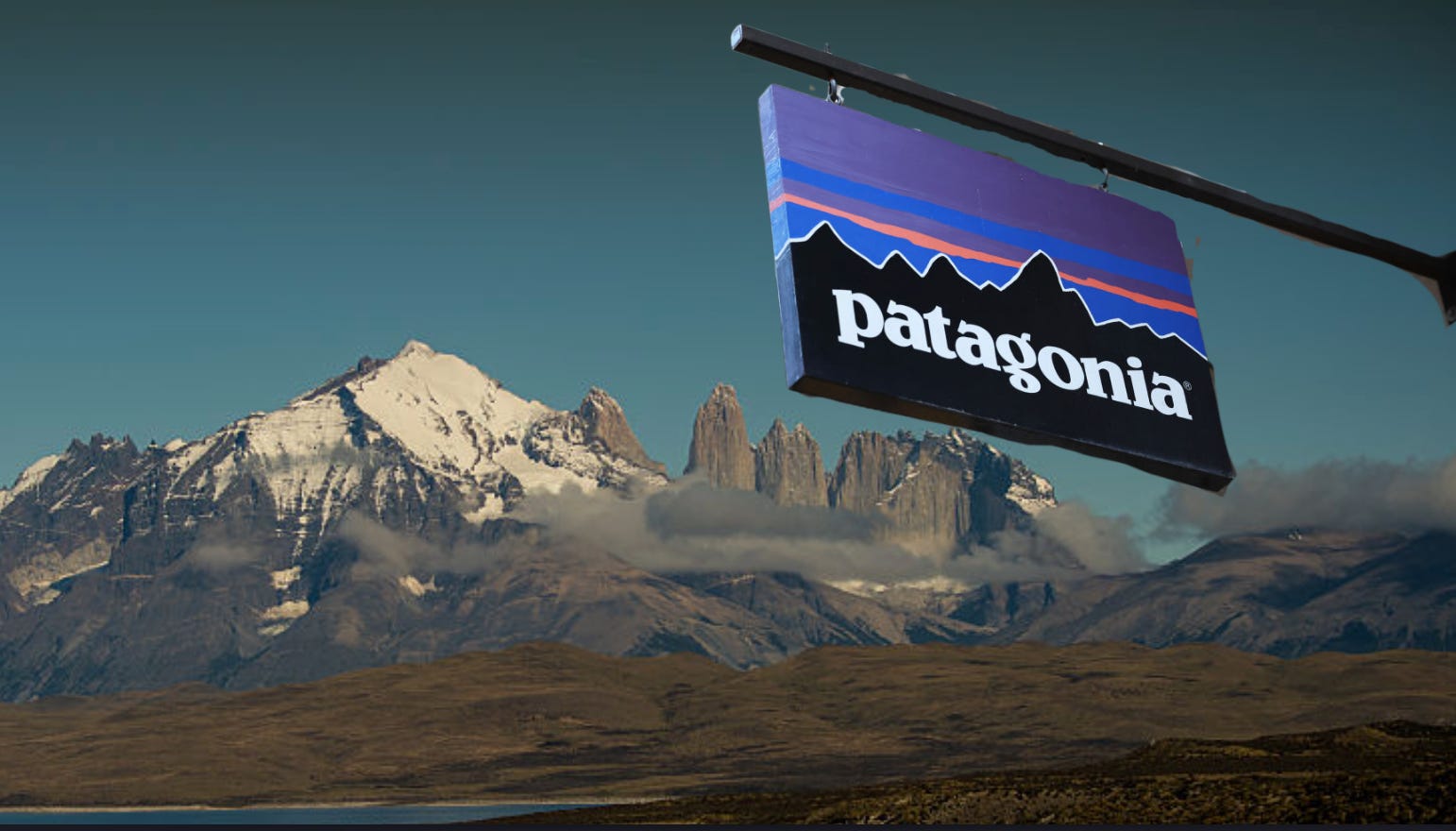
How can Patagonia, the brand, own the name of a geographical region? That’s the most common question I keep seeing asked about Patagonia™’s controversial lawsuit against Pattie Gonia, the environmental activist and drag queen.
I’m interested in that question myself—not just legally, but morally. Because as I’ve been reading through all the lawsuit coverage, I’ve noted that almost no one is talking about what this dispute means for Patagonia as an actual place, shaped by Indigenous histories, colonial conquest, and ongoing struggles over land and sovereignty.
So over the last couple days, I did two things. First, I spoke with a trademark law professor to understand how a company can legally trademark a geographic term in the first place; what rights that trademark actually gives it; and whether Patagonia™ really “had no choice” but to sue Pattie Gonia in order to protect its brand.
Then, I spoke with two scholars of Patagonia, colonialism, and Mapuche self-determination to understand the deeper politics behind the name itself: how “Patagonia” became a colonial fantasy of empty wilderness, how that fantasy obscures the Indigenous people and histories still rooted there, and what it means for a U.S. corporation to profit from that mythology while policing how others use it.
The legal question of place ownership
One of the strangest things in Patagonia™’s lawsuit against Pattie Gonia appears in paragraph 19 of the complaint, where the company describes its trademarks as “fanciful.”

In trademark law, “fanciful” means “a completely made up term,” said Alexandra Roberts, a trademark law professor at Northeastern University. “So like Excedrin, Rolex, Xerox, stuff like that,” she said. “And that kind of mark gets the broadest protection.”
This is, of course, false. Patagonia is a real place: A vast region at the southern end of South America, spanning parts of present-day Argentina and Chile. So for Roberts, the fact that the company describes the mark as “fanciful” is “shocking and obnoxious,” she said. “It’s definitely disingenuous.”
The “fanciful” claim probably won’t matter to the outcome of the lawsuit, Roberts said. But it does highlight what’s bothering so many people about it. Patagonia™ appears to be asserting ownership rights over the name of a real place. How can it do that, legally?
The short answer is: Pretty easily. “Geographic names can absolutely be trademarks,” Roberts said. There are a bunch of rules, but in this case, what matters is that Patagonia™ is not using the word Patagonia to tell consumers where its clothes come from. It is using Patagonia to tell consumers who its clothes come from.
Over many decades, Patagonia™ has successfully made the name of a real place function as the name of a company that has little to do with the place itself. This is not unusual: Amazon is a rainforest and a river and also one of the world’s most powerful corporations. Andes is a mountain range and also a brand of mint chocolate candy. Tahoe, Yukon, and Denali are places and also SUVs.
These companies don’t own the place itself; rather, they own the commercial meaning they have built over years around those names. For Patagonia™, that means they own the use of “Patagonia” as a brand for apparel and outdoor gear.
Did Patagonia have to sue Pattie Gonia?
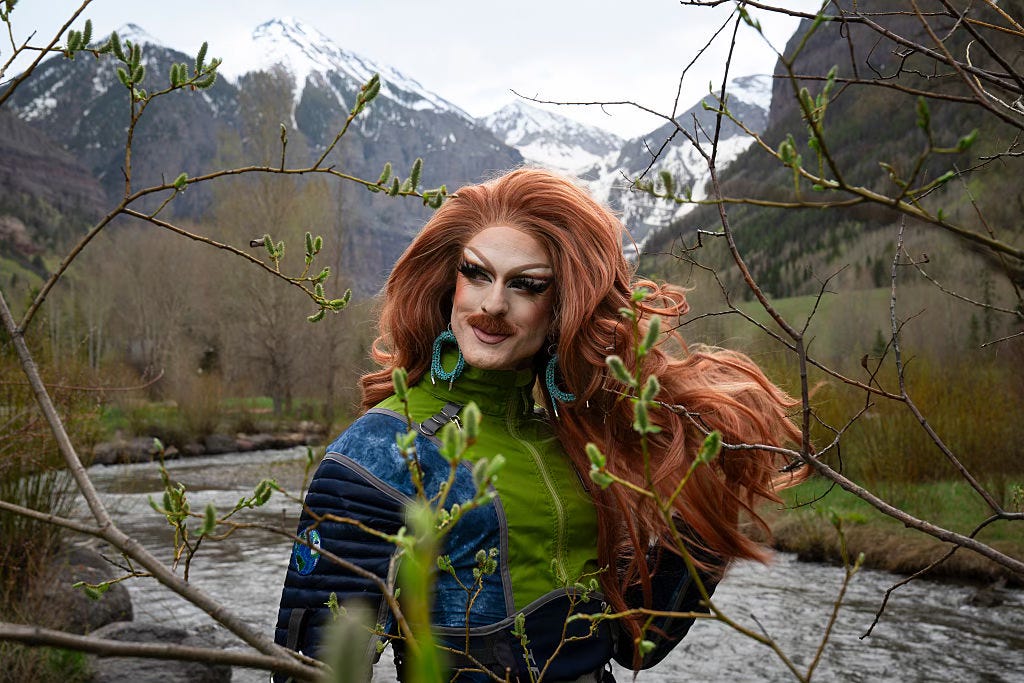
Now, before we get into the deeper ethical question of what it means for a company to build a brand out of a place it did not create, there’s one more legal argument worth clearing up.
There’s a common claim that, because Patagonia™ owns this trademark, it had no choice but to sue Pattie Gonia over her attempts to file a trademark for selling clothing. If it didn’t, Patagonia™ risked weakening its trademark and opening the door for others to use the name too.
Roberts, however, doesn’t buy it. “That is BS,” she said. “I think that is dramatically overblown.“

The idea that all companies must aggressively defend their trademarks against all potential violators, or else risk losing their right to that trademark, is “kind of a myth or a misconception,” Roberts said. “Declining to sue one infringer doesn’t tend to hurt that owner in his case against another infringer,” Roberts said.
“Litigants like to say that it matters, and lawyers whose job it is to send cease-and-desist letters and file lawsuits like to say it matters,” Roberts said. “But there’s not good evidence that it does matter.”
Roberts compared it to Taylor Swift. Swift can let small fan artists sell handmade Swift-inspired goods on Etsy, while still reserving the right to sue major commercial infringers. “That’s her choice,” Roberts said. “Nobody’s going to say to her in court, ‘Oh, but what about all these little users on Etsy that you didn’t go after?’”
Trademark policing does matter in certain cases, Roberts said. If a company allows one specific infringer to use its mark for years, then tries to sue that same infringer later, a court may say it waited too long. And if there’s very clear, blatant infringement going on all around a company, and they don’t take action against any of it for a long time, then that may affect the company’s ability to sue in the future.
”But when it’s not a straightforward slam dunk case, and you make a decision as a company that it isn’t good for your brand to sue, that’s not something that will hurt your ability to enforce later,” Roberts said.
That distinction matters because this legal argument is Patagonia™’s moral alibi. The company is framing the lawsuit against Pattie Gonia as something it was reluctantly required to do, rather than something it affirmatively chose to do.
But according to Roberts, Patagonia™ did have a choice. And once you understand that, the larger ethical question becomes harder to avoid.
Patagonia© vs. Patagonia the region
For Dr. Claudia Briones, an anthropologist and editor of Contemporary Perspectives on the Native Peoples of Pampa, Patagonia, and Tierra del Fuego, the premise of this entire trademark fight is outrageous.
“No company or individual could ever ethically claim exclusive commercial rights over a regional name like Patagonia,” Briones told me. “Capitalism or capitalist interests can neither transform everything into merchandise nor swallow up and benefit from everything in its own exclusive benefit.”
Her outrage speaks to the deeper ethical question underneath Patagonia™’s lawsuit against Pattie Gonia. Legally, Patagonia™ may have built trademark rights around the word “Patagonia” as a brand name for outdoor clothing and gear. But morally, Briones argues, the company is still doing something harmful: turning the name of a real region, with real people and histories, into private commercial property.
“It’s outrageous that a corporation that exploits a name as part of its marketing sues others for doing the same,” Briones said. “They should ask for permission, apologize, and share part of their profits with the most vulnerable residents of the region.”
To be fair, Patagonia© does fund environmental organizations in Argentina and Chile, and has supported conservation work in the region. But conservation philanthropy is not the same thing as accountability to the people whose lands, histories, and landscapes helped make the brand valuable in the first place.
“Patagonia has been always interpreted by outsiders in ways that serve their interests,” said Lucas Savino, an associate professor in the Centre for Global Studies at Huron University College and author of Decolonizing Patagonia: Mapuche Peoples and State Formation in Argentina. “This particular lawsuit, it's almost another episode of that long story of Patagonia being up for grabs.”
How outsiders marketed Patagonia to claim it
To understand what Savino means, you only need a little bit of history.
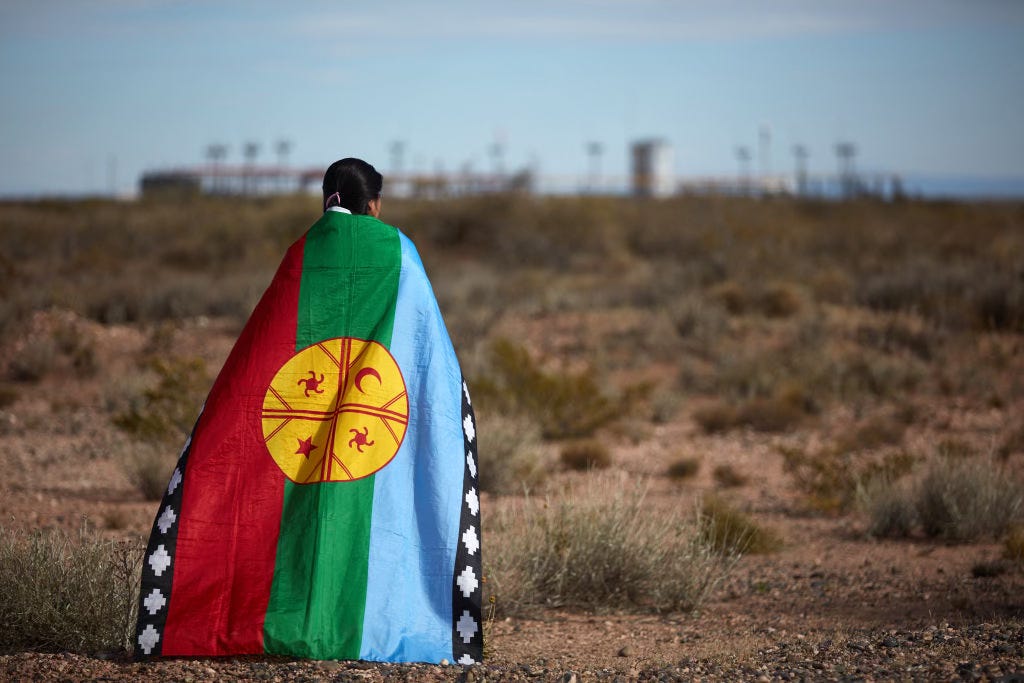
Long before Patagonia became a global shorthand for fleece jackets, it was home to Indigenous peoples, including Mapuche and Tehuelche communities. The name “Patagonia” itself is a colonial label from the 1500s, derived when Spaniards encountered Indigenous Gününa-këna and Aoinikenk peoples whom they called “Patagone” because of their supposedly large feet.
But the most important history for understanding Savino and Briones’ critique is what happened in the late 1800s, when the emerging states of Argentina and Chile wanted to control the region. In order to justify conquering it, they marketed the region as a “desert”—a place that was, effectively, empty.
“For the states of Chile and Argentina to dominate Patagonia, they needed to first make it a desert,” Savino said. “So they had to imagine it as a desert, as a place of wilderness that needed the forces of civilization.”
But Patagonia was not a desert, nor was it empty. Still, that marketing was used to justify what’s now known as the “Conquest of the Desert”—a bloody Argentine military campaign that slaughtered “more than 1,000 Mapuches, displaced more than 15,000 more from their traditional lands and enslaved a portion of the remaining Indigenous people.”
”Even to this day, in those communities, they speak of acts of genocide,” Savino said.
That is why Savino sees Patagonia™ as participating in a much longer pattern: powerful outsiders defining Patagonia for their own purposes.
“I always think of Patagonia, the company, as replicating the corporate version of the 19th century military campaigns by the Argentine and the Chilean states,” Savino said.
Savino emphasized he was not trying to draw a direct equivalence between a corporation using a regional name and a state committing genocide. His point was about the underlying logic: In both cases, Patagonia became useful only after it is turned into an image of empty wilderness.
That image is still powerful today. Briones said Patagonia continues to be marketed as “pristine, sparsely populated, and beautiful nature,” even though the region contains many ecosystems, communities, and political struggles. Governments still see it as a place of “natural resources” to be exploited through oil, gas, mining, wind energy, forestry, and tourism projects. Mapuche and Mapuche-Tewelche communities, meanwhile, continue to fight for recognition, land, and self-determination.
So when Patagonia™ builds a brand out of the region’s name, landscapes, and wilderness mystique, Briones argues that it is not simply borrowing a pretty word. It is profiting from a story about Patagonia that has always been politically loaded.
That is where the company’s environmental image becomes complicated. Patagonia© is globally admired for its environmental advocacy. But Briones said its version of environmentalism still appears rooted in a classed, consumer-friendly idea of nature—one disconnected from many of the people who actually live in the landscapes the company invokes.
Savino made the same point more bluntly: “The Indigenous peoples I work with there, I work with these rural communities for the most part—some are urban—but they could never even afford a piece of Patagonia.”
Does the critique apply to Pattie Gonia, too?
Briones and Savino both saw a meaningful difference between Patagonia™ and Pattie Gonia, the drag artist.
“I don’t know Pattie Gonia, but I suspect there must be a big difference since she is not a corporation, right?” Briones said. (Technically, Patagonia™’s lawsuit is against Pattie Gonia’s corporation, Entrepreneur Enterprises, Inc.)
Either way, however, Briones said Pattie Gonia should be clear about what the name is meant to do: whether it is a critique of the company, or whether it also relies on “a more or less idealized vision” of the region’s landscapes. In the first case, Briones said, “her sarcasm would be excused.” In the second, “explanations and apologies are also in order.”
Savino similarly said the scale is different. Patagonia, the company, uses the regional name “without sarcasm, without irony, without humor,” then builds its corporate image around the fantasy many consumers already have of the place. Pattie Gonia’s name, by contrast, appears to be “part of artistic expression,” he said. “The name change is witty.”
But the deeper question, Savino said, is not only who gets to use the name. It is who gets to define what Patagonia means. “The story is more than the name,” he said. “It has to do with who also gets to control the narrative of what Patagonia is.”
As for what accountability would look like, Briones acknowledged there is no simple answer. But she said Patagonia™ could start by acknowledging what it has done: using a region’s name, landscapes, and mythology to build a global brand without real permission from the people most connected to that place.
“The company could apologize for not having asked for permission and for commodifying a region,” she said. A possible form of compensation, she added, should happen locally, among “vulnerable residents and environmental organizations of the places whose landscapes are used for the Company’s promotional purposes.”
As a whole, they say the issue is not just whether Patagonia™ has a legal right to enforce its trademark. It is whether a corporation should be able to turn a real place into a brand, profit from the fantasy of that place, and then claim the power to decide who else can use its name.
After just a few conversations, I don’t have a perfect answer to that. But I do think it’s worth asking.
Note: I’ve reached out to a number of Indigenous activists and organizations in Patagonia to get their take. I’ll update you if and when I hear back.
Hey!! If you’ve gotten this far, and you’re new here, I’m Emily and I do all the reporting, writing, editing, fact-checking, and legal worrying for HEATED myself. I don’t take ads, run sponsored content, take corporate money or nonprofit funding. That’s how I keep this work 100 percent independent—and, as much as possible, free for everyone to read.
If you have the means to support this journalism, please consider becoming a paid subscriber. It’s the only reason I’m able to do this work the way I do it. Thank you!!
Up here in Maine, Third Act Maine has been asking another iconic outdoor company, L.L. Bean to stop using Citibank for its credit card services. Citi is one of the dirtiest banks in the world, gleefully financing fossil fuel projects. We have also reminded L.L. Bean that research shows that parking your profits in a Citi account significantly increases your carbon footprint. If the dirtiest banks were a country they would rank as number four in carbon emissions worldwide. LL Bean is not interested, it's all about customer benefits from their Citi card. By contrast, Patagonia offers no credit card and they acknowledge the harm done by banking with Chase, Citi. Wells, and BOA. They park their money with green banks. So, Emily, perhaps your next segment could be about the greenwashing masters at LL. Bean, whose marketing slogan is , "the outside is inside everything we do". NOT!
such good and necessary journalism!!!!!!!!!!!!!!!!