
Bari Weiss vs. climate change
At The Free Press, Weiss consistently rebrands tired fossil fuel talking points as courageous, rebellious dissent.

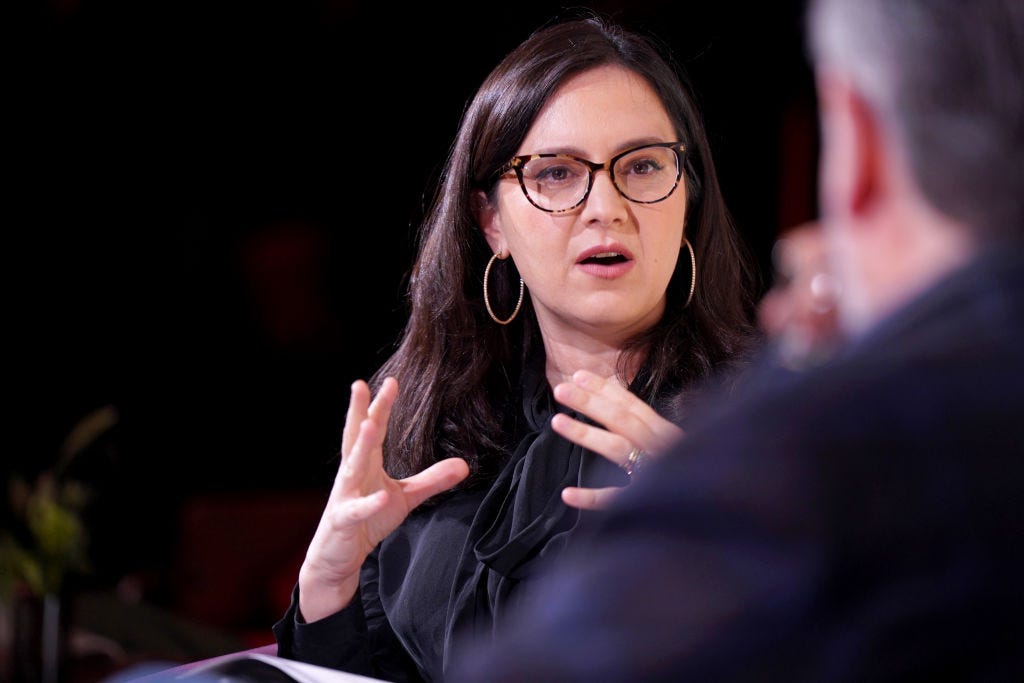
In theory, I should be a fan of The Free Press, the outlet founded by Bari Weiss.
The publication preaches “honesty, doggedness, and fierce independence.” I founded HEATED on the same principles. The Free Press also promises to chase stories “that are ignored or misconstrued in the service of an ideological narrative.” Similarly, my mission has always been to pursue climate stories that challenge profit-driven ideological narratives about the crisis.
In practice, however, I’ve found that The Free Press doesn’t live up to its stated values when it comes to climate change reporting. Over and over, it allows its readers to get spun like a basketball on Big Oil’s finger.
I’m looking at The Free Press for a very specific reason. Weiss is the new editor in chief of CBS News. And last week, as I reported, CBS laid off almost its entire climate unit, widely regarded as one of the strongest climate reporting teams in national television news.
There’s no confirmation that Weiss was involved in those layoffs. But without that team, the best clue we have about the future of CBS’s climate coverage is the climate coverage Weiss has already overseen.
For this reason, I recently read every climate change article The Free Press has published since 2021. And for all its rhetoric of challenging “ideological narratives,” the outlet has never once interrogated the dominant ideological narratives the fossil fuel industry and its allies have spent decades refining: namely, that climate impacts are not that serious, that meaningful solutions are unrealistic and/or stupid, and that fossil fuels represent the only path to prosperity.
Instead, The Free Press tends to publish climate pieces that reinforce polluter-friendly framing. To show you what I mean, here is a list of the outlet’s standalone climate articles, and the tired fossil fuel talking points they attempt to rebrand as rebellious free thought.
“Climate Change Did Not Cause The L.A. Fires.” This is a Q&A interview with Steve Koonin, a former BP scientist hired by the Trump administration to co-author a report downplaying the severity of climate change. He argues wildfires aren’t getting worse due to climate change, and that climate change isn’t that big a deal. (Climate impacts are not that serious).
“The Truth About Climate Change ‘Lies Somewhere in the Middle’” This is yet another Q&A interview with Steve Koonin, in which he argues the U.S. will always need fossil fuels and downplays the severity of the climate problem. (Climate impacts are not that serious).
“Stop Making Plane Turbulence About Climate Change.” This op-ed argues that reporters must stop linking plane turbulence to climate change because the science isn’t 100 percent certain yet. (Climate impacts are not that serious).
“I Helped Make Standing Rock Go Viral. Now I Regret It.” This first-person essay from a former climate activist who is now The Free Press’s social media editor documents her transition to “Free Thinker,” in part by reading fossil fuel lobbyist Alex Epstein’s book. She writes: “Do fossil fuels cause our planet to warm? Yes. They also make modern life possible, freeing women from hours of labor and empowering us in a million different ways.” (Fossil fuels are the only path to prosperity).
“Everybody Freeze! It’s the Climate Police.” This is an op-ed by an anonymous author called “Doomberg” railing against a Canadian city’s air quality and climate ordinance to ban remote car starters. (Solutions are impossible/improbable).
“Divesting from Big Oil is an Empty Gesture.” In this op-ed, longtime climate policy naysayer Joe Nocera argues that fossil fuel divestment is “pointless” and “useless.” (Solutions are impossible/improbable).
“Earth to Democrats: Americans Still Love Fossil Fuels.” This op-ed by a fellow at the American Enterprise Institute–a conservative think tank funded by fossil fuel billionaires–argues that Americans love fossil fuels and hate climate policy so Democrats should just abandon it. (Solutions are impossible/fossil fuels are the only path to freedom).
“The Triumph of the Plastic Straw.” This op-ed celebrates the return of the plastic straw, which includes accusations that the media and activists have lied about the severity of climate change to create panic. (Climate impacts are exaggerated).
“I Thought Climate Change Would End the World. I Was Wrong.” This is an op-ed by Ted Nordhaus. Its title is fairly self-explanatory. (Climate impacts are exaggerated).
“I Left Out the Full Truth to Get My Climate Change Paper Published.” A first-person essay by scientist Patrick T. Brown claiming he left out non-climate factors driving wildfires in order to get a paper published. (Climate impacts are exaggerated)
“Climate Activism Has a Cult Problem.” A first-person essay by a former Extinction Rebellion activist saying the people he used to work with were gross because they left dishes in the sink and didn’t wear shoes in the office. (Solutions are impossible/improbable).
Of all the standalone climate articles I found on the Free Press, only one did not reinforce a familiar fossil fuel industry talking point. An op-ed published last year argued against emitting more climate-cooling aerosols into the atmosphere to help tackle climate change, since aerosols also contribute to air pollution. It struck me as a reasonable argument—albiet a curious choice of focus, given that no country or government is seriously proposing such a strategy.
But overall, The Free Press really only pursues climate stories that fit the publication’s preferred ideological narrative: that climate change isn’t a serious problem; that scientists and activists are silly for worrying about it; and that fossil fuels are the path to our brightest future.
And in some cases, to pursue that preferred ideological narrative, The Free Press distorts the facts. Longtime climate journalist Sammy Roth pointed this out in his recently-launched newsletter last week, calling out The Free Press’s recent video about Bill Gates’ new climate essay urging against “doomsday” rhetoric:
To hear the Free Press tell it, Gates backtracked on his decades of climate work, aligning himself with a tiny handful of contrarian scientists who claim global heating is no big deal. The video implied (without saying so explicitly) that Gates admitted fossil fuels are “cheaper, faster and more reliable” than clean energy.
Not even close.Gates’ arguments were controversial among many scientists and environmentalists (for reasons I’ll address in a future post). But he stated plainly that climate change is a “very important problem [that] needs to be solved,” and that “every tenth of a degree of heating that we prevent is hugely beneficial because a stable climate makes it easier to improve people’s lives.” Gates wrote that solar, wind and electric cars are “just as cheap as, or even cheaper than, their fossil fuel counterparts.”
The Free Press also has a habit of staging “takedowns” of climate claims that aren’t actually being made, a disingenuous tactic meant to portray mainstream climate scientists and advocates as unhinged. For example, its Q&A with a former BP scientist was titled “Climate Change Did Not Cause the LA Fires.” But no prominent politician, activist, journalist or scientist who cares about climate change actually says climate change caused the wildfires. They say climate change increased the risk of damage and made them worse. Come to think of it, the aerosol op-ed fits in this category, too.
And yet—perhaps surprisingly—I do think some of the climate-adjacent topics The Free Press takes up have journalistic value. For example, the wildfire scientist’s essay about pressure from academic journals to focus solely on climate drivers, rather than local policy failures, raises genuinely important reporting questions. And the former Extinction Rebellion activist’s essay highlights a problem that extends far beyond climate organizing: narcissistic, self-aggrandizing movement leaders who prioritize personal image over the cause.
But these are serious issues that call for real, rigorous reporting (as other outlets have done), not first-person grenades lobbed to generate outrage and reinforce the right-wing fantasy that climate change is not a big deal. And that, unfortunately, is what The Free Press’s climate coverage is designed to do.
If this is the model for how CBS News will now approach its climate coverage, the shift will not be toward independence, but capitulation. Instead of challenging power, CBS will be helping launder the fossil fuel industry’s preferred narratives through the language of free thinking. That would not only misinform the public, it would leave people materially less prepared for the realities of a warming world.
Let’s hope the past doesn’t predict the future.
Have a news tip? Contact me securely via Signal at emorwee.06
Other stories I’m following:
Exxon funded think tanks to spread climate denial in Latin America, documents reveal. A new bombshell from Geoff Dembicki at The Guardian:
Hundreds of previously unpublished documents … reveal a coordinated campaign to make the global south “less inclined” to support the UN-led climate treaty process. … The money Exxon sent to Atlas Network helped finance Spanish and Chinese translations of English books denying that human-caused climate change is real; flights to Latin American cities for American climate deniers; and public events that allowed those deniers to reach local media and network with politicians.
Scientists criticize ‘straw man’ arguments in Bill Gates climate memo. Also at The Guardian, Dharna Noor clears up climate deniers’ disingenuous framing of the Gates memo, and provides criticism and context from climate scientists.
In his memo, Gates wrote that global warming “will not lead to humanity’s demise”. This misunderstands climsate scientists’ warnings, said Katharine Hayhoe, chief scientist at the Nature Conservancy. “I have not seen a single scientific paper that ever posited that the human race would become extinct … it’s a straw man, the way he’s proposing it,” she said. “He’s speaking about it as if scientists are saying that, and we’re not: what we are saying is that suffering increases with each 10th of a degree of warming.”
Why should anyone care what Bill Gates thinks about climate change? Laura Malden at The New Republic captures some of my own feelings. Though mine more surround the fact that Bill Gates is not a climate scientist, she makes a good point:
By using headlines as a thought-chyron for billionaires, rather than as an opportunity to call attention to the problem of their obscene wealth consolidation, news outlets risk legitimizing billionaires’ hyper-privileged viewpoints through clicks. This can perpetuate flawed understandings of reality, driven by people with the morally questionable motivation to be wealthier than most countries across the globe.
Here’s What to Know About the COP30 Climate Talks in Brazil. This year’s United Nations climate summit got underway in Belém, Brazil, on Thursday. Here’s a short guide from The New York Times.
Catch of the Day: Forget carbon capture—Griffindor Kingsley (aka Gryffin) has a champion underbite that has mastered sophisticated crumb capture and sequestration.

Thanks to reader Josh for the submission.
Want to see your furry (or non-furry!) friend in HEATED? Just send a picture and some words to catchoftheday@heated.world.
This expose is one of the most important articles you’ve published Emily. Bari Weiss is a very dangerous character precisely because as you say she claims to represent courageous and unorthodox ideas but a close read will see that she almost never criticizes the horror of what Donald Trump and his minions are doing to this country.
The article that the Press published by Zion Light on XR would be better appreciated if it were paired with an article refuting many of her conclusions particularly about Roger Hallam.
This is my favorite kind of journalism! Although I wish I could say I was surprised by what you found. Even if we take the Free Press editorial team at face value that they're committed to "honesty" and "fierce independence," it's clear that they're chasing clicks with these types of articles rather than trying to inform their readers.
The question for me is if they're being fed these fossil fuel talking points by a specific actor, or if the misinformation is so deeply ingrained that they don't even realize whose arguments they're parroting.